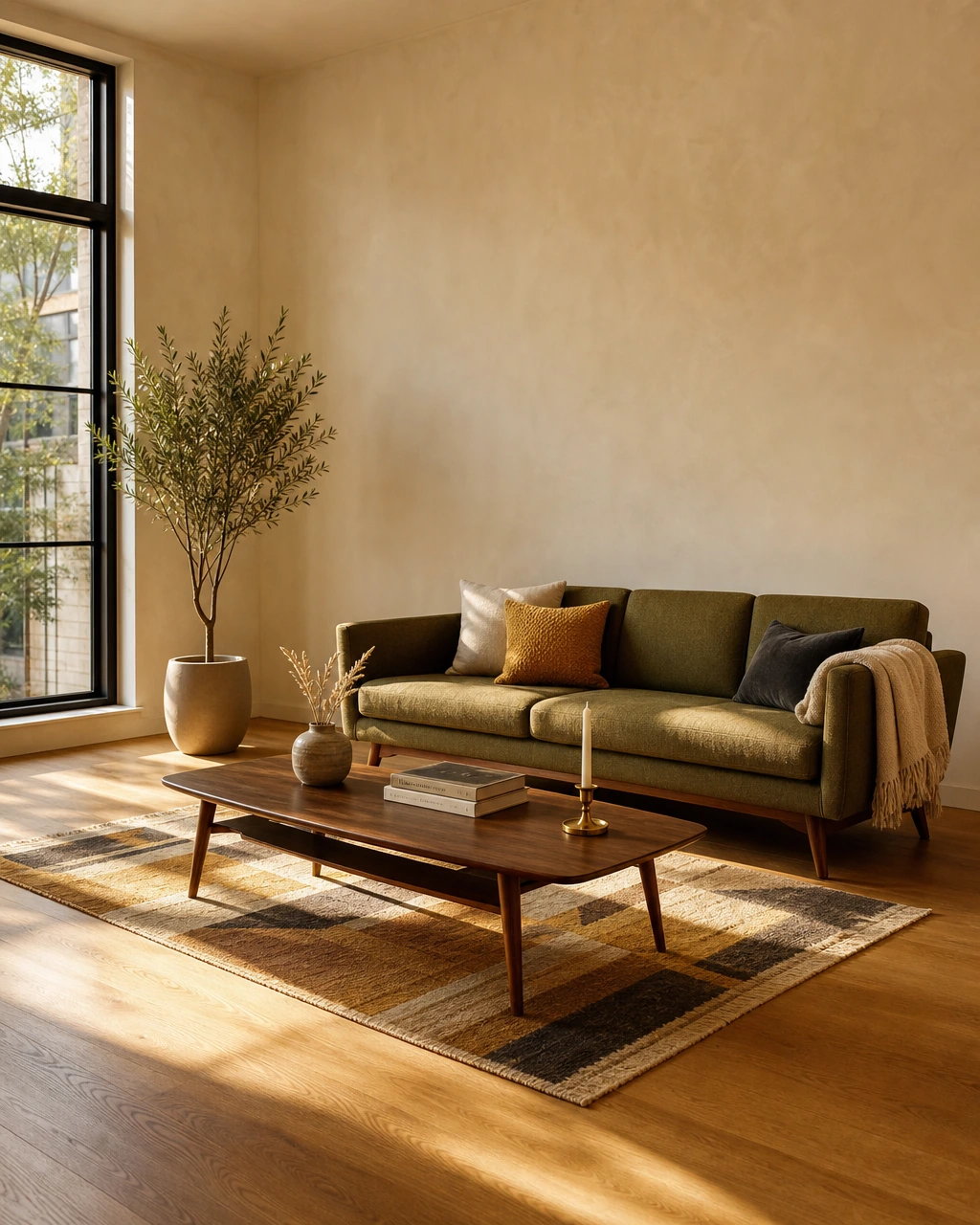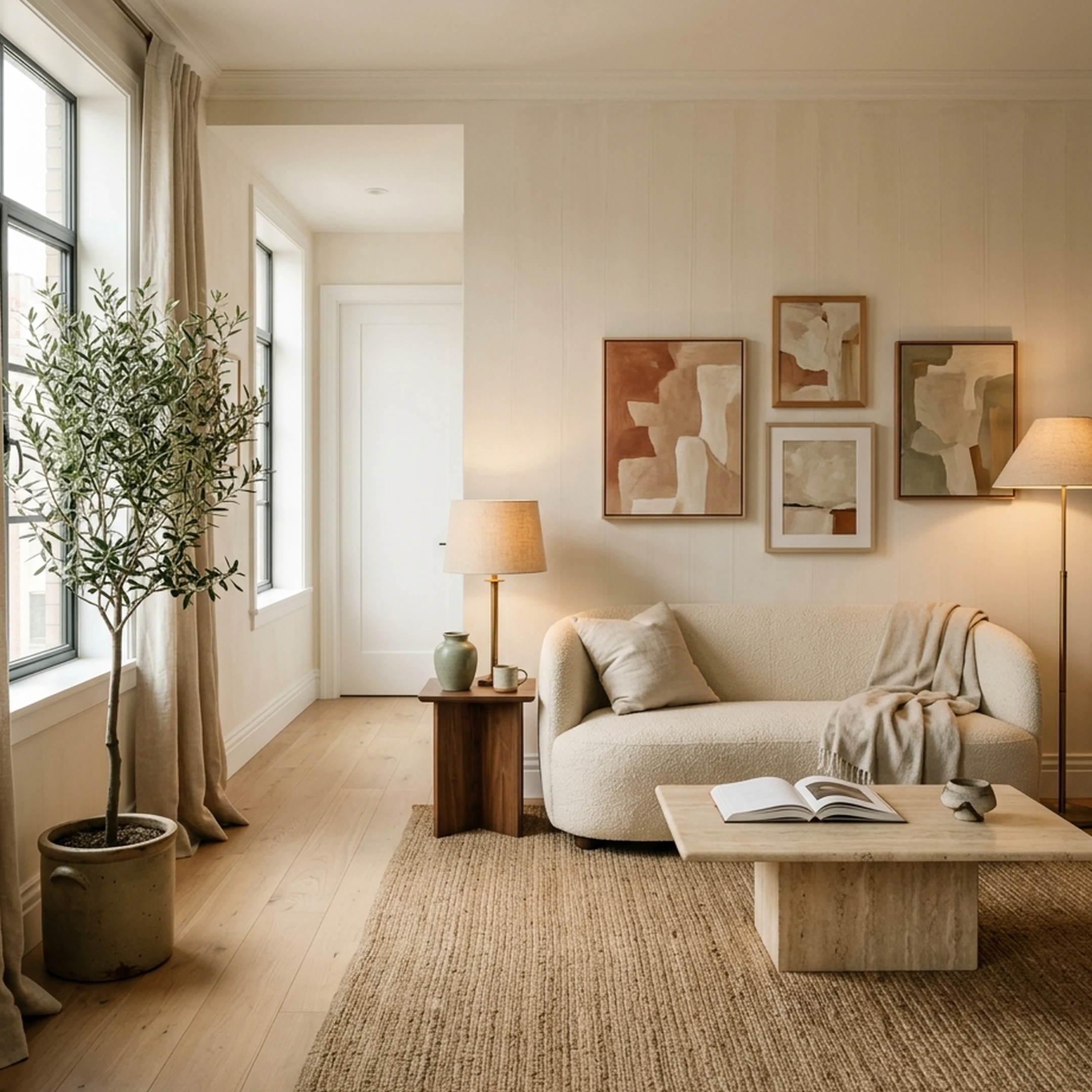
You bought your first place in Chicago three months ago. The closing costs are paid. The moving boxes are mostly gone. Now you're standing in an empty living room trying to decide whether the budget should go toward the sofa, the dining table, the rug, or the lighting.
Every choice seems connected to five others. The rug affects the sofa. The sofa affects the coffee table. The lighting changes everything. Before long, a straightforward furnishing budget starts feeling like a puzzle with no obvious starting point.
This is where most design budgets go wrong. Not because people lack taste, but because translating a vision into actual purchases is harder than it looks. First Chair exists to close that gap, turning saved images and aesthetic direction into curated, purchasable room concepts that work within real budgets. The statistics on interior design spending reveal something useful: understanding where homeowners typically allocate their money makes it easier to prioritize the pieces that do the most work and avoid costly detours along the way.
Key Takeaways
- Design fees represent only 10-20% of your total project budget but determine how efficiently the other 80-90% gets spent, making professional guidance a leverage point rather than a luxury expense
- Furnishings and case goods consume 25-40% of most interior design budgets, with furniture alone accounting for 35% of the global interior design market, so this is where smart allocation matters most
- Renovation projects now dominate the market at 47.85% share with the highest projected growth at 11.78% CAGR, meaning most homeowners are working with existing spaces rather than blank slates
- Metropolitan projects cost 30-50% more than identical work in smaller markets, which explains why that Brooklyn apartment refresh feels so much steeper than what your parents spent in the suburbs
- A 10-15% contingency buffer separates finished projects from budget disasters, yet most first-time furnishers skip this line entirely and regret it by month three
- Mid-range interior design services capture over half the market at 53.37% share, which means you don't need luxury-tier budgets to get cohesive, well-designed spaces
1. Global Interior Design Market Value Reaches $153.85 Billion
The global design services market sits at $153.85 billion in 2026. This massive market encompasses everything from residential projects to commercial spaces, luxury penthouses to budget apartment makeovers. The scale reflects how universal the need for well-designed spaces has become across all income levels and property types.
2. US Interior Design Services Market Worth $26.5 Billion
The US market alone represents $26.5 billion of the global total. Regional market concentration explains why certain cities have become design capitals. New York, Los Angeles, and San Francisco account for disproportionate shares of this spending, with project costs running 30-50% higher than national averages in these metro areas.
3. Furniture Accounts for 35% of Interior Design Market
Furniture represents 35% of the global interior design market. This single category dominates spending because furniture provides both the functional foundation and aesthetic anchor for any space. Sofas, dining tables, beds, and seating consume more budget than any other design element.
4. Lighting Captures 22% of Market Share
Lighting comprises 22% of the interior design market. This often-overlooked category transforms rooms more dramatically than most homeowners expect. A well-chosen pendant fixture or strategically placed floor lamp elevates entire spaces, while poor lighting undermines even expensive furniture.
5. Furnishings Account for 25% of Design Market
Furnishings beyond furniture represent approximately 25% of the market. This category includes built-in cabinetry, shelving systems, window treatments, and case goods that blur the line between furniture and architecture. These pieces often require custom work or specialized installation.
6. Design-Only Projects Cost $2,000 to $15,200
Design-only services typically run $2,000 to $15,200 excluding furniture purchases. These projects cover concept development, space planning, color selection, and detailed product specifications without the designer handling procurement or installation. Clients receive a complete roadmap but execute purchases independently.
7. Full-Scope Projects Start at $25,000
Complete design projects including design fees, furniture, and materials start around $25,000 for professional execution. This figure covers everything from initial consultation through final installation, with the designer managing all sourcing, ordering, delivery coordination, and styling.
8. Complete Home Furnishing Costs 10-20% of Home Value
Total home furnishing often lands at 10-20% of home value when done through design professionals. A $400,000 home reasonably supports $40,000-80,000 in design and furnishing spend, phased over multiple years as homeowners refine their preferences and budget allows.
9. Renovation with Design Totals 25-50% of Home Value
Renovation projects combined with design can total 25-50% of home value when structural changes accompany furnishing. Moving walls, updating systems, and reconfiguring layouts consume significant budget before a single piece of furniture gets purchased. These projects require careful phasing to avoid capital exhaustion.
10. Metropolitan Projects Cost 30-50% More Than Smaller Markets
Projects in major cities like Los Angeles, San Francisco, or New York cost 30-50% more than identical work in smaller markets. Labor rates, delivery logistics, space constraints, and higher designer fees all contribute to metropolitan premiums. That Brooklyn one-bedroom renovation might match suburban three-bedroom costs in the Midwest.
How First Chair Solves Budget Planning Challenges

The statistics reveal a consistent problem: knowing what to spend and where to allocate funds requires expertise most homeowners lack. Traditional design services solve this through high-cost consultation, but that pricing excludes budget-conscious furnishers who need guidance most.
First Chair bridges this gap with AI-assisted curation that interprets your aesthetic direction and generates cohesive room concepts using real, purchasable pieces. You see exactly what your space could look like with proper allocation before spending anything. The platform sources across West Elm, CB2, Crate & Barrel, Pottery Barn, and Lulu & Georgia, finding pieces that work together within your actual budget.
11. Design Fees Represent 10-20% of Total Project Budget
Design fees typically represent 10-20% of total project budget when working with professionals. This percentage feels high until you realize it determines how efficiently the other 80-90% gets spent. A skilled designer prevents the $3,000 sofa that doesn't fit through the doorway or the five separate accent chairs when one statement piece would work better.
12. Hourly Designer Rates Range from $100 to $500
Hourly design rates span from $100 to $500 depending on experience and market. Entry-level designers in smaller cities start around $100-150 per hour, while established professionals in major metros command $300-500. A typical room design consumes 10-20 hours, putting consultation costs at $1,000-10,000 before purchasing anything.
13. Percentage-Based Fees Run 10% to 30% of Total Budget
Percentage-based design fees typically fall in the 10% to 30% range of total project budget. A $30,000 furniture budget incurs $3,000-9,000 in design fees under this structure. Higher percentages usually apply to smaller projects where minimum fees need coverage, while larger projects trend toward the lower end.
14. Cost-Plus Models Add 17% to 45% Markup Over Retail
Cost-plus pricing applies a 17% to 45% markup on furnishings over retail price. Designers with trade accounts purchase at discount, then resell to clients at full retail or slightly above, capturing the spread as compensation. This model was industry standard for decades but has become less common as retail pricing transparency increased.
15. Furnishings and Case Goods Consume 25-40% of Budgets
Furnishings and case goods consume 25-40% of most interior design budgets. This category includes cabinetry, built-in shelving, window treatments, and specialty storage solutions that require custom fabrication or professional installation. These pieces bridge furniture and architecture, often demanding longer lead times and higher precision.
16. Soft Goods and Accessories Account for 10-15% of Budgets
Soft goods and accessories typically represent 10-15% covering textiles, art, and decorative objects. This category includes throw pillows, blankets, curtains, artwork, vases, and styling elements that personalize spaces. These items finish rooms but shouldn't dominate spending.
17. Construction and Architectural Changes Represent 35-60% of Renovation Budgets
Construction costs dominate renovation budgets at 35-60% when structural work is involved. Moving walls, updating electrical, replacing flooring, or reconfiguring layouts all land in this category. These costs have no design workarounds. The demolition costs what it costs, and until structural work completes, furnishing decisions wait.
18. Renovation Contingency Should Be 7-8% of Construction Costs
Renovation contingency specifically should be 7-8% due to increased unknowns when opening existing walls. Standard new construction might budget 3-5% contingency, but renovation work almost always surfaces surprises. Outdated wiring, unexpected water damage, or structural issues hiding behind drywall all require budget flexibility.
19. Overall Project Contingency Should Be 10-15% of Total Budget
General project contingency runs 10-15% for complete design projects. This covers not just construction surprises but also shipping damage requiring furniture replacement, pieces that don't fit and need returns, and accessories discovered necessary only after major pieces arrive. The buffer separates finished rooms from budget disasters.
20. Standard Project Contingency Runs 3-5% for New Construction
Standard contingency for straightforward projects without renovation runs 3-5%. New construction with predictable timelines and no existing conditions to discover needs less buffer than renovation work. This lower percentage still protects against the inevitable small issues that arise in any building project.
First Chair Makes Professional Curation Accessible
The data shows that design fees consume 10-20% of budgets while determining how efficiently the remaining 80-90% gets spent. Traditional hourly and percentage-based pricing makes professional guidance inaccessible precisely when it matters most: for budget-conscious homeowners making foundational purchasing decisions.
First Chair removes this barrier through curation that provides design-level direction without design-level fees. You upload inspiration images, describe your aesthetic preferences, and receive curated room concepts using real furniture from trusted retailers. Every piece is shoppable, every price is visible, and the entire concept works together because it was selected as a cohesive collection.
New members get a limited-time $100 gift. For anyone building a budget-conscious room, starting with credit applied toward professionally curated pieces makes the economics work from the beginning.
21. Mid-Range Services Dominate at 53.37% Market Share
Mid-range design services capture 53.37% of market share. This tier serves design-conscious homeowners on projects that feel elevated but not extravagant. The category sits between budget DIY approaches and luxury concierge services, offering professional guidance without couture pricing.
22. Premium and Luxury Services Grow at 13.84% CAGR
Premium luxury services lead growth at 13.84% CAGR despite smaller overall volume. Wealth migration to high-amenity cities and branded residence developments drive this expansion. Ultra-high-net-worth individuals increasingly expect white-glove design services included with premium real estate purchases.
23. Renovation and Remodeling Account for 47.85% of Market Share
Renovation projects now dominate at 47.85% of market share. Most homeowners work with existing spaces rather than blank slates. Tight housing inventory, high mortgage rates, and aging housing stock all push people toward improving current homes rather than moving.
24. Renovation Segment Grows at Highest Rate of 11.78% CAGR
Renovation holds the highest projected growth at 11.78% CAGR among all design service segments. Economic factors favoring aging in place over frequent moves accelerate this trend. Baby boomers renovate to age-friendly specifications while younger homeowners improve starter properties purchased at peak prices.
25. Residential Designers Emphasize Renovation Over New Construction at 70% to 30% Ratio
Residential designers now work on renovation over new construction at a 70% versus 30% ratio. The industry has fundamentally shifted. Professional designers spend most project time on spaces with existing conditions, structural limitations, and integration challenges rather than ground-up builds.
26. Homeowners Spent $463 Billion on Renovations in Q1 2024
American homeowners spent $463 billion on renovations in the first quarter of 2024 alone. This staggering figure, representing just three months of activity, shows how renovation has become ongoing lifestyle maintenance rather than occasional investment. Homeowners continuously improve spaces rather than treating homes as static purchases.
27. 55% of American Homeowners Planned to Renovate
55% of homeowners planned renovation projects, up from 52% the previous year. Majority participation means renovation is no longer niche activity but mainstream homeowner behavior. More than half of all property owners actively plan improvements at any given time.
28. Interior Design Software Market Grows at 10.3% CAGR
Interior design software grows at 10.3% CAGR, projected to reach nearly $10 billion by 2030. Investment follows demonstrated value. Software that helps people furnish spaces more efficiently captures budget that would otherwise go toward trial and error or expensive designer consultation.
29. One-Third of Design Professionals Actively Use AI Tools
Approximately one-third of architecture and design professionals now actively use AI tools in their work, with another third anticipating adoption soon. The industry shifts because AI solves real workflow problems like faster iteration, broader product sourcing, and consistent scale matching, not because of hype.
30. Designer Specification Impact Estimated at 40x Typical Consumer Buying Power
The average designer's specification impact is estimated at 40 times greater than a typical consumer's buying power. Designers have sourcing knowledge, trade relationships, volume leverage, and trained eyes that consumers lack. A designer specifying furniture for 20 projects annually wields far more influence than a homeowner furnishing one apartment.
31. Interior Design Costs $5 to $15 Per Square Foot Nationally
National design services typically cost $5 to $15 per square foot. A 1,000-square-foot home incurs $5,000-15,000 in design fees, varying by project complexity and designer experience. This benchmark helps set expectations, though actual costs depend heavily on scope and market positioning.
32. New York City Design Costs $100 to $200 Per Square Foot
New York City projects run $100 to $200 per square foot for larger projects with full professional involvement. The dramatic premium over national averages reflects metropolitan complexity, space constraints, union labor requirements, and designer positioning. A 1,000-square-foot Manhattan apartment incurs $100,000-200,000 in total design and execution costs.
33. 66% of Homeowners Prefer Cost-Effective Decor Like Fresh Paint
66% of homeowners prefer cost-effective home decor like fresh paint as renovation starting points. Paint transforms rooms faster than furniture and costs a fraction as much. A bedroom painted thoughtfully in the right warm white or muted sage creates a foundation that makes even basic furniture look intentional.
34. 41% of Homeowners Seek Open Layouts in Renovation Priorities
41% of homeowners prioritize open layouts in their renovation planning. The preference reflects how Americans actually live: cooking while entertaining, working while supervising children, and using spaces flexibly rather than formally. Open concepts command premium pricing in real estate because demand consistently exceeds supply.
35. Average Renovation Spending Increased by $12,000 While Furnishings Averaged $5,000
Homeowners increased spending on renovations by an average of $12,000, while furnishings averaged $5,000 according to homebuilder surveys. These numbers suggest most households can furnish meaningfully without extreme budgets when spending is prioritized correctly. The renovation premium over furnishing costs reflects that structural work drives total expenses.
Frequently Asked Questions
What percentage of home value should I spend on interior design for a first home?
Most guidance suggests 10-20% of home value for complete interior design and furnishing. For a first home, the lower end of that range makes sense. You're still learning your preferences, and rooms evolve as you live in them. Focus budget on foundational pieces like sofas, beds, and dining tables. Leave room to upgrade accessories and art as taste develops. A $400,000 home reasonably supports $40,000-80,000 in total design and furnishing spend, phased over the first few years of ownership.
How do I budget for interior design when working with an existing furnished space?
Start by auditing what you have. Separate pieces into keep, replace, and undecided categories. The replacement list sets your furniture budget. Then add 15-20% for accessories and styling that integrate old pieces with new. Most people overestimate how much needs replacing. A quality existing sofa might just need different pillows and a new rug to feel refreshed. Design fees for working with existing furnishings typically run lower than full-scope projects since sourcing volume decreases.
Should I hire a designer for a small apartment or handle it myself?
Small apartments benefit from design expertise precisely because constraints are tighter. The wrong-scale sofa in a 600-square-foot apartment creates bigger problems than in a 2,000-square-foot house. That said, traditional design fees may not make sense for studio or one-bedroom projects. Consider alternatives like First Chair for curated direction without hourly fees, or e-design services that provide room concepts at fixed project rates. The goal is getting professional perspective on scale and proportion without the overhead of full residential design services.
How do contingency budgets work for furnishing versus renovation?
Renovation contingency covers unknowns that emerge during construction. Opening walls reveals outdated electrical. Removing flooring exposes water damage. These costs can't be predicted and must be budgeted at 7-10% of construction costs. Furnishing contingency serves different purposes. It covers shipping damage requiring replacement, pieces that don't fit and need returning, and accessories that turn out necessary after furniture arrives. A 10-15% furnishing contingency protects against the normal friction of putting a room together.
What's the best way to save money on interior design without sacrificing quality?
Concentrate spending on the pieces you touch and use daily. Sofas, dining chairs, mattresses, and primary seating deserve quality budgets. Complement them with secondhand case goods, vintage accessories, and budget-tier decorative objects. Mix one statement lighting fixture from Rejuvenation or Visual Comfort with simpler pieces elsewhere. Use paint strategically since color transforms rooms cheaply. Avoid buying complete sets from single retailers. The savings come from strategic allocation, not across-the-board cheapening. One excellent sofa surrounded by thoughtfully sourced secondary pieces beats a room full of "good enough" furniture at the same total spend.