If you signed a lease in NYC, LA, Chicago, Austin, or Miami in the last year, you already know the math. The square footage in the listing was generous. The walls aren’t. The doorway is somehow narrower than the loveseat you fell for online, and the elevator is narrower than the doorway.
The average new US apartment is now 908 square feet and shrinking. In Manhattan and Brooklyn it’s smaller still. The result is a generation of design-forward renters with great taste and rooms that fight them. The problem isn’t your eye. It’s geometry. Solve geometry first. Style second.
This guide is the geometry guide. How to measure, what clearances actually matter, what pieces earn their footprint, where to spend, where to skip, and how to pull off a room that looks intentional in the square footage you actually have. First Chair closes the part after the geometry, turning a verified-fits concept into pieces you can buy this week.
Key takeaways
- Measure everything: room dimensions, doorways, hallways, stairwells, elevators. Twice. Before you fall in love with anything.
- Leave 30-36 inches for major walkways and 18 inches between coffee tables and sofas.
- One properly-scaled standard piece beats three small pieces fighting for attention.
- Furniture with visible legs makes rooms feel larger by showing more floor.
- Vertical space (floor-to-ceiling shelving, tall narrow chests) is the unused resource.
- Look for “come-apart” pieces that disassemble for delivery through tight stairwells.
Measure first, fall in love second

Grab a tape measure before anything else. The unsexy part of furniture shopping that saves you from expensive returns and delivery disasters.
Critical clearances:
- Walkways: 30-36 inches for major paths through a room
- Coffee table to sofa: 18 inches minimum
- Dining chair clearance: 36 inches behind a chair to push back from the table
- Bedroom clearance: 24-30 inches around three sides of a bed
- Door swing clearance: the full arc of any door has to stay clear
The delivery path check
Measure your front door, your hallway width and turning corners, your stairwell, and your elevator (height, width, depth). Standard sofa frames don’t disassemble. If a piece is 84 inches and your stairwell turn is 78, no amount of love will get it upstairs.
Look for “come-apart” pieces in tight buildings like sofas and sectionals that ship in pieces and assemble inside. Article and Burrow both make come-apart designs that move through 28-inch doorways without drama.
The pieces that actually earn their footprint
Small space living is a reward function for multi-purpose furniture. If a piece only does one job, it had better be spectacular at that one job. The pieces pulling the most weight in city apartments:
- Lift-top coffee tables. Laptop stand by day, dinner-on-the-couch surface by night. CB2 and West Elm both make ones in clean profiles.
- Storage ottomans. Footrest, extra seating, hidden storage for blankets and remotes. Skip the cheap stamped-leather versions and spend on one in performance velvet that looks like furniture, not utility.
- Console tables behind sofas. A 12-inch-deep console doubles as a desk, an entryway drop, and a buffet during a dinner party. Crate & Barrel and West Elm both have ones at the right scale.
- Sleeper sofas with mattresses you’d actually let a houseguest stay on. Article and West Elm both nail this. The compromise is real but the gap between “fine” and “miserable” is wider than the price gap.
- Nesting tables. Stack to one footprint, separate when company arrives. CB2 and Lulu & Georgia carry ones that look intentional, not utilitarian.
Demand for flexible interiors has jumped 35% as remote work reshaped how people use their homes. The market caught up. The pieces are out there.
Living room layout: counterintuitive but proven
Here’s where most people get it wrong: small furniture doesn’t make small rooms feel bigger. Many small pieces fragment a room visually. The eye bounces between objects and the gaps between them feel like wasted space.
One properly-scaled standard sofa beats three small chairs every time. A 78-inch sofa anchored against the right wall in a 10×12 room reads as intentional. Four 24-inch chairs in the same room reads as a waiting area.
If a full sofa won’t fit, look for apartment-scale sofas, proportionally sized, not just chopped shorter. 72 inches, with the same depth and seat height as a standard piece. Article and West Elm both make ones that hold up for years.
Layout essentials for tight rooms:
- Sofas under 38 inches deep
- Track arms over rolled because they save 4-6 inches per side
- Armless accent chairs in tight corners
- Furniture placed at angles to create the illusion of depth
- Float the sofa away from the wall (when room allows) for a console behind it
The studio apartment play
Maybe you’re in a studio because you just landed in a new city and this is what the budget allows. Or you bought your first place and 500 square feet in Brooklyn costs more than a house elsewhere. The goal is the same: make one room feel like a home, not a compromise. That starts with zones.
Zone creation strategies:
- Rugs anchor zones. One under the sofa for living, a different one (or bare floor) for sleeping.
- Open shelving as room divider. Lets light through, defines space without walling it off.
- Sofa-back as boundary. A sofa with its back to the bed makes a psychological wall.
- Lighting zones. Brighter task light over the desk, warmer ambient over the bed.
- Curtains for privacy. Ceiling-mounted track curtains close off sleeping when you have guests.
Bed solutions in studios:
- Murphy beds transform sleeping into living during the day. Modern mechanisms are smooth and one-person-operable.
- Storage beds with drawers eliminate the need for a separate dresser.
- Platform beds with clearance fit storage bins or a low desk underneath.
Studio layout rule
Put the bed against the wall farthest from the entry. The first thing guests see should feel like a living room, not a bedroom.
Where to spend, where to save
Small apartments don’t reward filling a room with cheap furniture. They reward editing. One or two anchor pieces hold the room together; everything else is allowed to be cheaper than it looks.
Spend on the daily-use pieces:
- The sofa. A West Elm Andes, a CB2 Lenyx, an Article Sven. Track arms over rolled. Legs visible, not skirted to the floor.
- The mattress. Saatva, Avocado, Tuft & Needle. Non-negotiable.
- One light fixture that doesn’t look like every other apartment. A Rejuvenation pendant, a Visual Comfort sconce, a vintage brass piece from Chairish. One distinctive light source elevates the whole room.
Save on the supporting cast:
- Side tables and coffee tables. West Elm, CB2, vintage from Chairish. Real wood and a clean line go further than the price tag suggests.
- Throw pillows, ceramics, art prints. H&M Home, Etsy, the actual art fair you went to last spring. This is the layer you’ll swap every two years anyway.
- Rugs (sometimes). A vintage Beni Ourain from Lulu & Georgia is the splurge. A Beni-style synthetic from RugVista or Revival looks 80% as good for 20% of the price and survives renters with shoes.
The trap to avoid
The matched 5-piece living room set from a single retailer. The whole point of an edited room is that the pieces look like they met each other on purpose, not in the same Wayfair catalog.
Visual tricks that actually work
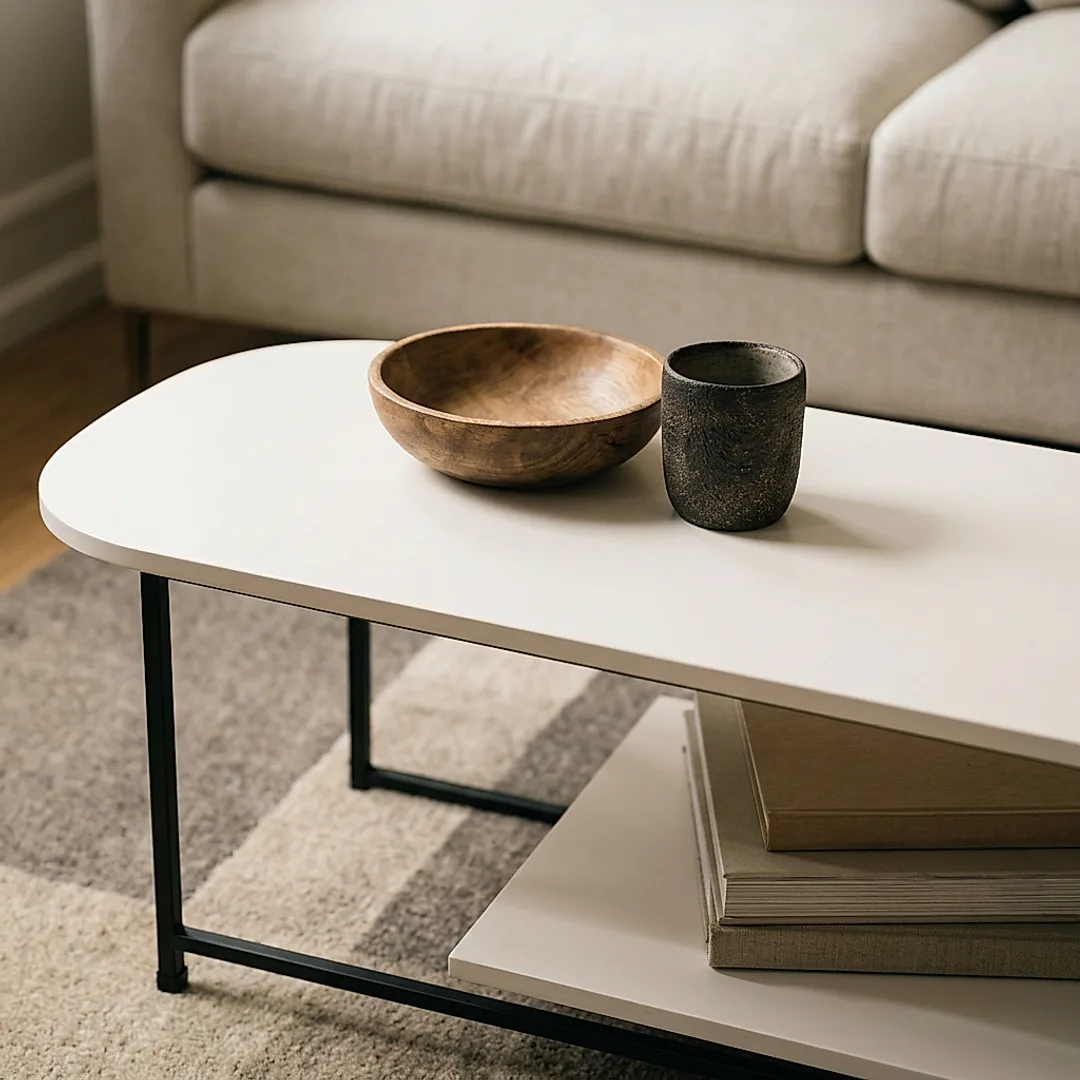
In rooms under 500 square feet, every design decision amplifies. The tricks worth doing:
- Light walls and floors. Reflect more light, expand spatial perception.
- Consistent flooring throughout connected rooms. Visual continuity reads as more space.
- Furniture with legs, not skirts. Visible floor underneath = the eye reads more space.
- Glass or lucite tables. Sight lines pass through, less visual weight.
- Mirrors opposite windows. Bounce daylight deeper into the room.
- Floor-to-ceiling curtains. Hung wall-to-wall, not just window-width. Makes the wall read as taller.
Counter-counter-intuitive tip
Dark colors can work in a small room but only if you commit. Walls, ceiling, trim all in the same deep color (navy, charcoal, forest green) makes the boundaries dissolve and the room feels like a deliberate jewel box. Half-measures (one dark accent wall) emphasize the smallness instead.
What NOT to buy in a small city apartment
The honest list, the one most blogs won’t write:
Skip the matched 5-piece living room set.
It signals “I shopped at a single retailer” and reads as a furniture showroom, not a home.
Skip rolled-arm sofas in tight rooms.
Track arms save 4-6 inches per side. In a 10-foot living room, that’s the difference between “fits” and “blocks the walkway.”
Skip the “small space” branded pieces from mass retailers.
Small + cheap + branded-as-small usually means flimsy and short-lived. Buy a smaller piece in better quality instead.
Skip the giant sectional.
A sectional in a small apartment locks the room into one configuration forever. A sofa plus one accent chair is more flexible and reads better.
Skip the “fits anywhere” futon.
Buy a real sleeper sofa or a real bed. The futon is an apartment red flag.
Style without leaning preset
The Scandinavian look done in warm woods rather than the all-white version. Mid-century with softer silhouettes like rounded arms, deeper seats, less bone-thin. Minimalism with soul, not the sterile gallery version. The collected look without it feeling cluttered.
These are how a design-literate renter actually describes what she wants. The point isn’t to pick a preset. It’s to pick a layered take. A room that says “she has a point of view” instead of “she ordered the catalog.”
The pieces that make the layered look land: a vintage anchor (rug, art, or one furniture piece), a contemporary heroic piece (the sofa, usually), one statement light fixture, and supporting cast in coordinated but not matching tones.
How First Chair helps you find furniture that actually fits
Knowing what to look for is the first half. Finding it across 30 brands without losing a weekend is the second half. That’s the half First Chair handles.
Upload a photo of your room (or describe it). We come back with a complete concept built from real dimensions verified for your space, sourced across the brands you’d already shop, with insider pricing built in. The room you’ve been pinning since you signed the lease, turned into a list of pieces you can buy this week.
What this looks like in practice:
- Every piece shown is real, shippable. No fantasy renders. No pieces that turn out to be sold out for six months.
- Multi-brand recommendations across West Elm, CB2, Crate & Barrel, Pottery Barn, Lulu & Georgia, Article, and the rest of the top 50 US brands.
- Style language that holds nuance. “Mid-century but warmer” and “Scandinavian without the cold” translate into actual concepts.
- Confidence without the chaos. Instead of 47 browser tabs, you get direction.
For urban renters dealing with tight layouts, unusual room shapes, and the constant question of “will this even fit?” having a trusted eye narrowing the field changes everything.
Free during early access, including $50 in furniture credit on your first checkout. Get early access.
Frequently Asked Questions
What are essential pieces for a small city apartment?
Start with the daily-use anchors: a comfortable sofa or loveseat, a bed with storage, a table that flexes between dining and working, and lighting that layers well. Prioritize multi-functional pieces over single-purpose furniture. A lift-top coffee table, a storage ottoman, and wall-mounted shelving will serve you better than traditional pieces that only do one job.
How do I make a small living room feel larger?
Choose pieces with visible legs to allow light underneath and maintain sight lines. Lighter colors and slim profiles. Avoid overstuffed sofas that visually dominate. Mirrors strategically placed to bounce light. And counter-intuitively: one properly-scaled standard sofa works better than multiple small pieces creating visual clutter.
Are there styles that work best in small apartments?
Style matters less than scale and proportion. Any aesthetic can work in a small space if the pieces are appropriately sized and visually light. Scandinavian and mid-century lean small-space-friendly because of clean lines and exposed legs, but a small room done in moody colors with the right furniture can be just as effective.
What are common mistakes to avoid?
Buying without measuring delivery paths (doorways, stairwells, elevators). Choosing on looks alone without checking dimensions. Filling rooms with too many small pieces instead of fewer well-scaled ones. Ignoring vertical storage. And skipping the legs or pieces that sit flush on the floor make rooms feel heavier and smaller.