
A data-driven look at where interior design is heading, what it costs, and why turning inspiration into a finished room remains so difficult
You signed a lease in Brooklyn eight months ago. The Pinterest board has 347 pins. The sofa you almost bought twice is still sitting in a saved cart somewhere. Meanwhile, the living room looks exactly like it did on move-in day, minus one plant that didn't survive February. This gap between knowing what you want and actually getting there? It's not just you. It's an industry-wide pattern backed by billions of dollars in research. First Chair exists precisely because of this disconnect, helping design-minded people turn saved inspiration into rooms they can actually buy.
Key Takeaways
- The interior design market is massive and growing. The global industry hit $137.93 billion in 2024 and is projected to reach $175.74 billion by 2030.
- Renovation dominates new construction. Remodeling accounts for 47.85% of the market with the highest growth rate at 11.78% CAGR.
- Furniture takes the biggest budget share. Roughly 35% of interior design spending goes toward furniture alone.
- The workforce is predominantly female. In 2023, about 84% of interior designers were women.
- Mid-range dominates spending. The mid-range price tier holds 53.37% market share, though premium and luxury segments are growing fastest.
- AI tools are adding real value. Generative AI design visualization is adding +0.6% to CAGR forecasts and reshaping how people shop for furniture.
Current Market Size and Growth Projections
1. The global interior design market was valued at $137.93 billion in 2024
This figure establishes that interior design is not a niche hobby. It's a global industry with serious economic weight. This scale reflects growing demand for thoughtfully designed spaces that balance aesthetics and lifestyle needs.
2. The market is projected to reach $175.74 billion by 2030
That's a 27% increase in just six years. This growth shows rising homeownership rates, remote work setups, and people spending more time caring about how their spaces feel.
3. Expected CAGR of 4.3% from 2025 to 2030
This 4.3% compound annual growth rate suggests a maturing market with consistent demand rather than a speculative bubble. This trend will continue to steady as more people continue investing in better-designed homes, workplaces, and lifestyle spaces.
4. Alternative projections put 2025 market value at $145.96 billion
Fortune Business Insights offers a slightly higher baseline, projecting growth to $214.35 billion by 2034. Across these reports, the overall trend shows higher demand for interior design as people place more value on well-designed spaces.
5. The interior design services market specifically sits at $153.85 billion in 2026
Mordor Intelligence forecasts this segment reaching $204.23 billion by 2031, growing at 5.83% CAGR, and driven by factors like post-pandemic hybrid work policies driving home office investment and technology making design services becoming more accessible.
6. Asia-Pacific holds 38% of global market share
The region leads globally, driven by rapid urbanization in China, India, and Southeast Asia. Fast-growing cities, smaller apartments, and rising design expectations are pushing more consumers toward digital-first furniture shopping and room planning options.
7. North America accounts for 33.5% of the market
Grand View Research places North America second, with strong spending on both residential and commercial projects. More shoppers are investing in homes that feel personal and worth spending time in.
8. Europe captures 24% market share
Fortune Business Insights notes Europe's stable position, with heritage renovation projects and sustainability regulations driving demand. Buyers across the region favor thoughtful renovation over fast-turnover furnishing.
9. The U.S. market generated $35.01 billion in 2024
According to Grand View Research, the U.S. alone represents a substantial portion of North American activity, expected to reach $41.7 billion by 2030. The category will keep expanding as more consumers treat furnishing as part of building a home that actually reflects them.
10. There are 157,000 interior design businesses in the United States
This IBISWorld figure shows how fragmented the industry remains. Most firms are small, serving local markets. The demand is there, but for many consumers, getting design help still feels expensive, slow, or hard to access.
Who Works in Interior Design? Salary Expectations and Job Descriptions
11. Interior designers held about 87,100 jobs in 2024
The Bureau of Labor Statistics tracks this number, which has remained relatively stable over recent years. This shows that the demand for design guidance is growing faster than access to traditional design services.
12. Employment is projected to grow 3% from 2024 to 2034
This modest growth rate reflects industry maturity. About 7,800 openings are projected annually, mostly from retirements and career changes. The industry is steady, but traditional design still struggles to scale with how people shop and furnish today.
13. The median annual wage was $63,490 in May 2024
BLS data shows wide variation. The lowest 10% earned under $38,480, while the top 10% exceeded $106,090. The spread reflects how much the industry still rewards reputation, specialization, and access to higher-end projects.
14. Designers in architectural services earn the most at $75,850 median
Working within architecture firms pays better than specialized design services ($64,120) or wholesale trade ($71,750). The highest-paying work tends to sit closest to large residential projects and full-scale space planning.
15. Average salary across all levels reached $69,958 in 2023
ASID reports this represents an 11.3% increase, suggesting strong demand for qualified professionals. As more consumers prioritize homes that feel intentional, design expertise is becoming more valuable across every level of the market.
16. Approximately 128,800 interior designers work in the U.S.
ASID's broader estimate includes self-employed practitioners, with roughly 55% employed and 45% working independently. The industry still runs heavily on small studios, freelancers, and designer-led businesses rather than large firms.
17. 33% of interior designers work in specialized design services
BLS data breaks down where designers actually work. Another 21% are self-employed, and 15% work in architectural or engineering services. The field remains highly distributed, with many designers building careers through boutique practices and independent client work.
18. In 2023, 84% of interior designers were women
The workforce remains heavily female, with 81.1% identifying as White. The profession continues to be shaped by women-led practices, especially across residential and lifestyle-focused design work.
What's Driving the Market in 2025 and 2026
19. Post-pandemic hybrid working adds +1.2% to CAGR forecasts
Mordor Intelligence identifies workplace redesign as the single largest trend driver. Companies are rethinking office layouts for collaboration and privacy. Companies are reshaping offices around flexibility, collaboration, and spaces employees actually want to spend time in.
20. Wellness-oriented materials add +0.8% to growth
The focus on healthier interiors includes better air quality, natural materials, and biophilic design elements. Design decisions are increasingly tied to how a space feels to live and work in every day.
21. ESG-linked green building certifications add +1.1% to CAGR
Sustainability requirements are no longer optional for commercial projects. This extends to residential spaces where eco-conscious consumers seek certified materials.
22. Personalized design experiences add +0.6% to growth
Consumers increasingly want to visualize their spaces before buying. First Chair helps bridge inspiration and action by creating curated room concepts using real furniture from brands like West Elm, CB2, Crate & Barrel, and Article..
23. Rapid urban construction in Tier-2 Asian cities adds +0.9%
Emerging markets in Asia are fueling long-term growth as middle-class populations expand. As more consumers move into newly built urban housing, demand for furnished, design-forward living spaces continues to rise.
AI in Interior Design
The gap between inspiration and execution has always been the hard part. You know you want "Scandi but warmer" or "minimalism with soul." Translating that into an actual room with real furniture you can purchase? That's where most people get stuck.
24. Room visualization experiences are changing consumer behavior
Even a modest +0.6% CAGR impact points to a major shift in how people shop for their homes. Consumers increasingly want faster, more personalized ways to visualize a space before making expensive furnishing decisions.
First Chair helps by creating curated, shoppable room concepts using real furniture from brands like Pottery Barn, Lulu & Georgia, Rejuvenation, and emerging retailers. Every piece is real and buyable. Not a render of a fantasy sofa that doesn't exist. Not furniture from a single retailer. Actual pieces from brands you love and brands you haven't discovered yet, pulled together into concepts that work as a room.
The Cost of Style
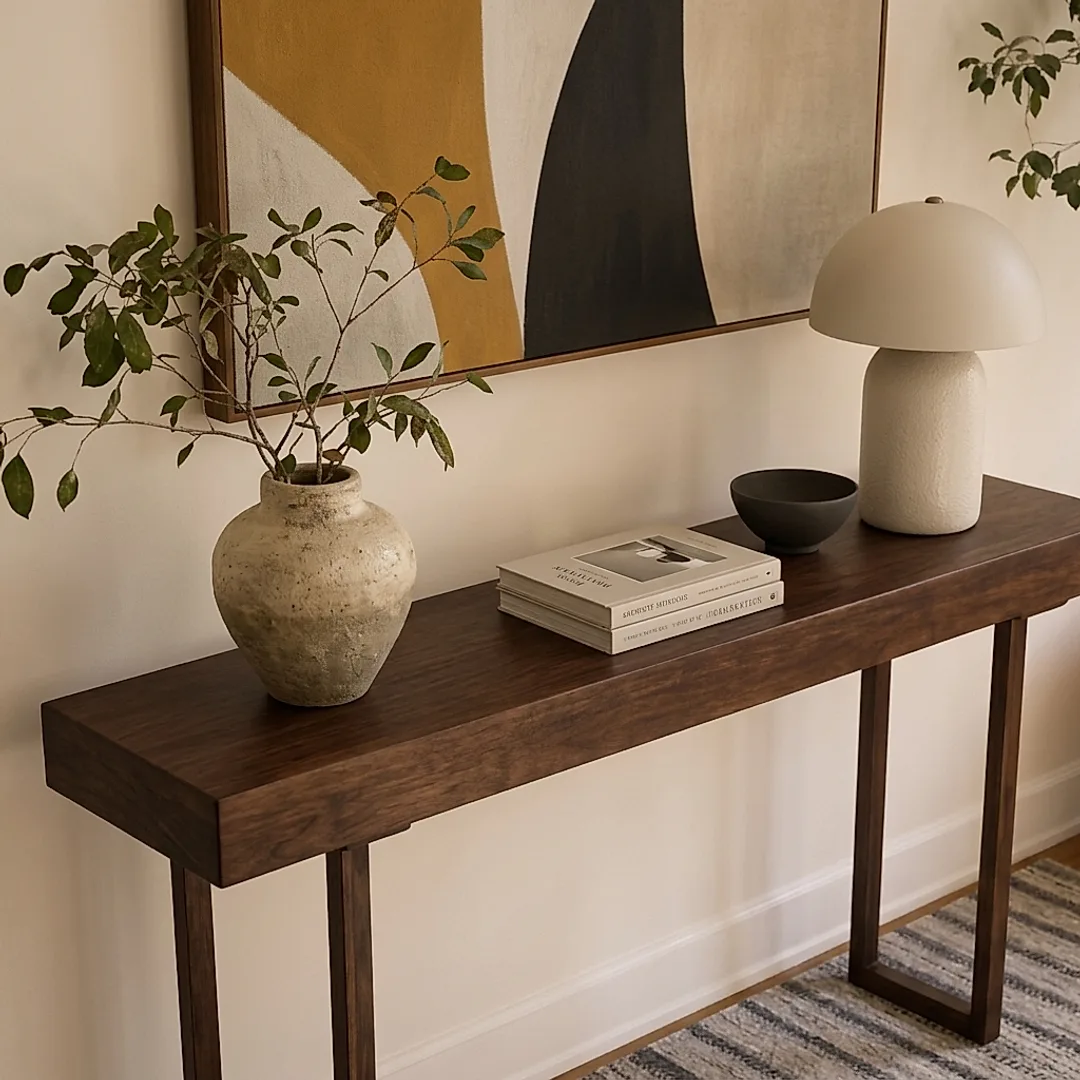
25. Furniture accounts for approximately 35% of interior design spending
Fortune Business Insights identifies furniture as the largest single category. Getting furniture right matters more than anything else. The biggest design decisions usually come down to the pieces people live with every day.
26. Furnishings represent around 25% of the market
Textiles, accessories, and soft goods make up the second-largest segment after core furniture pieces. A quarter of interior design spending now goes toward the layers that personalize and complete a room.
27. Lighting accounts for approximately 22%
Proper lighting transforms how spaces feel. This category includes everything from Visual Comfort fixtures to simple table lamps. This shows how much consumers value layered lighting, from statement pendants to softer ambient pieces that shape the mood of a room.
28. Flooring represents about 18%
Flooring investments tend to be longer-term decisions, often tied to renovation projects rather than decorating. Compared to furniture and furnishings, flooring changes happen less often and carry a much higher commitment.
29. Mid-range price tier holds 53.37% market share
Most people aren't shopping to the extremes. Mordor Intelligence confirms the middle market dominates, which is exactly where pieces from CB2, Article, and West Elm sit. Buyers want pieces that feel elevated and lasting without crossing into luxury pricing.
30. Premium and luxury segments are growing fastest at 13.84% CAGR
The high-end market attracts customers willing to invest in quality. Brands like RH, 1stDibs, and Serena & Lily serve this segment. This growth at the top end suggests more buyers are treating their homes as long-term expressions of taste, and not just temporary setups.
31. The market concentration remains low
Mordor Intelligence notes no single company dominates interior design services. The category is still highly fragmented, with consumers piecing together inspiration, advice, and shopping across dozens of disconnected brands and services.
32. Workplace design generated $1.52 billion in fees in 2025
Interior Design Giants data shows commercial workplace projects driving significant revenue for top firms. Companies are spending heavily to make offices feel more flexible, hospitality-driven, and worth commuting back to.
33. Healthcare design generated $945 million
Hospital and wellness facility projects represent the second-largest commercial segment. The scale of spending reflects how strongly healthcare spaces now prioritize comfort, calm, and patient experience alongside function.
34. Hospitality design brought in $602.7 million
Hotels and restaurants continue driving design innovation that eventually influences residential trends. Many of the looks homeowners now want at home first showed up in boutique hotels, cafés, and hospitality spaces.
Home Renovation Trends and Spending
35. Renovation and remodeling account for 47.85% of the market
Mordor Intelligence shows renovation matching new construction in market share. More buyers are reworking the homes they already have instead of starting over somewhere new. The focus has shifted from bigger homes to better-functioning ones.
36. Renovation is the fastest-growing segment at 11.78% CAGR
This growth rate outpaces every other segment. High mortgage rates make renovating more attractive than relocating. People make current spaces work harder and feel better instead of chasing more square footage.
37. New construction generated $95.33 billion in 2024
Grand View Research tracks new construction as still substantial, but growth is slower than renovation. Even with slower momentum, newly built homes continue creating major demand for furniture, lighting, and full-room furnishing decisions.
38. Commercial is the fastest-growing end-user at 12.26% CAGR
Mordor Intelligence notes offices, retail, and hospitality spaces are being reimagined post-pandemic. Businesses are investing in spaces that feel more flexible, experiential, and aligned with how people actually work and gather now.
From Inspiration Overload to Cohesive Outcomes
39. Residential interior design services hold 57.39% market share
Mordor Intelligence confirms homes are where most design money flows. Yet most homeowners never hire a designer. The gap between wanting a well-designed home and knowing how to pull one together is still massive.
40. South Africa is expected to register the highest CAGR through 2030
Emerging markets are expanding rapidly as middle-class populations grow. Faster growth outside traditional design hubs shows how global demand for better-designed living spaces keeps widening.
41. Middle East and Africa projected to grow at 17.33% CAGR
Mordor Intelligence identifies this region as the fastest-growing through 2031. This shows how quickly new urban development and rising consumer spending are reshaping demand for interior design services.
Building Design Confidence Through Expert Curation
The interior design industry is growing. People are spending real money on their homes. Renovation dominates new construction. And yet the actual experience of furnishing a room remains frustrating for most people.
The problem is that most people already know what they like. The problem is the 47 tabs. It's the saved cart with pieces that don't quite work together. It's the fear of committing to a $2,000 sofa only to realize it overwhelms the room.
First Chair addresses this gap directly. Upload inspiration. Describe what you're going for. Get curated room concepts using real furniture from brands like West Elm, CB2, or Pottery Barn. Everything shown exists, ships, and works together. Plus insider pricing on most pieces.
The room you've been picturing? It's closer than 347 Pinterest pins suggest.
Frequently Asked Questions
What is the projected growth rate for the interior design industry?
The global interior design market is expected to grow at a CAGR of 4.3% from 2025 to 2030, reaching approximately $175.74 billion. Some projections suggest even higher growth, with Mordor Intelligence forecasting 5.83% CAGR for interior design services specifically.
How much does it cost, on average, to hire an interior designer?
Designer compensation varies significantly. The median wage for interior designers is $63,490 annually, but project fees depend on scope, location, and designer experience. Many consumers opt for e-design services or AI-assisted platforms that provide guidance without hourly fees.
How does AI impact the job market for traditional interior designers?
Generative tools are adding +0.6% to industry CAGR, complementing rather than replacing designers. Employment is projected to grow 3% from 2024 to 2034, with about 7,800 annual openings. AI handles visualization and product discovery, while designers focus on complex spatial planning and client relationships.
What is the largest spending category in interior design?
Furniture accounts for approximately 35% of interior design spending, making it the single largest category. Furnishings follow at 25%, lighting at 22%, and flooring at 18%. Getting furniture right has the biggest impact on how a room feels.
Are online interior design services becoming more popular than traditional services?
Online interior design services are becoming more popular as people look for easier, more flexible ways to design their homes. With over 157,000 small interior design businesses in the U.S., the industry is still very fragmented, making digital platforms more appealing for consumers who want a simpler experience.
First Chair makes it easier to turn inspiration into fully designed, shoppable rooms using real furniture from multiple retailers. It’s a more approachable way to get design guidance without the time, cost, or commitment of working with a traditional designer.