There is a specific kind of frustration that hits when you finish a celebrity home tour and realize you have no idea what to do with any of it. You scroll through photos of Bad Bunny's Hollywood Hills mansion, or read about his Puerto Rico compound, and something clicks. The warmth. The restraint. The way the rooms feel social without feeling staged. Then you look at your own living room and the gap between the two feels impossible to close.
It is not impossible. The design principles behind his spaces, warm minimalism, conversation-first layouts, natural materials, and cultural specificity, are all translatable. You do not need a celebrity budget. You need to understand what is actually doing the work in those rooms, and then make deliberate moves with what you have.
This guide breaks down the real design logic behind Bad Bunny's residences and gives you a practical path to recreate the feeling in your own home. Whether you are furnishing a first apartment in Austin, refreshing a condo in Miami, or finally committing to the living room you have been putting off in Chicago, the principles here apply.
Here is what you will learn:
- The core aesthetic logic behind Bad Bunny's Hollywood Hills and Puerto Rico spaces
- How to design a conversation-centric living room without eliminating your television
- Which natural materials create the Latin-modern warmth his spaces are known for
- How to use color boldly without the room feeling chaotic
- The high-low purchasing strategy that makes luxury aesthetics accessible
- Which smart home upgrades have the most impact on how a space feels
- The most common mistakes that undermine this aesthetic, and how to avoid them
Key Takeaways
- Bad Bunny's living spaces prioritize conversation over screens, with sofas facing each other around a central table rather than orienting toward a television, a layout that designers say creates better balance and invites interaction.
- His Hollywood Hills home uses warm minimalist principles: simple lines, large glass openings, and restrained finishes that let light and views carry the room.
- "La Casita" in Puerto Rico was designed around emotional architecture, using materials, color, and spatial sequence to evoke memory and cultural identity rather than generic tropical motifs.
- Soft modern design (clean lines with warm textures) is the leading residential style direction among professional designers, making this aesthetic both current and durable.
- Consumers increasingly mix high and low purchases, investing in a few statement pieces while economizing on accessories, which is exactly how you recreate a luxury look on a real budget.
- Natural materials (wood, stone, rattan, warm metals) and muted, earthy color palettes are the foundation of the aesthetic, not expensive finishes or designer labels.
- Cultural expression in these spaces comes through art, objects, and spatial intention, not themed merchandise or surface-level motifs.
What Warm Minimalism Actually Means
Warm minimalism is a design approach that combines clean, modern architectural forms with tactile natural materials and muted color palettes, creating spaces that feel calm and considered rather than cold or sparse.
This is the clearest way to describe what connects Bad Bunny's various residences. His Hollywood Hills mansion uses simple volumes, large glass openings, and finishes that recede so that light and views become the focal point. His Puerto Rico spaces draw on Caribbean vernacular architecture, using materiality and spatial sequence to evoke memory and community. His New York penthouse brings a more layered, urban sensibility. What connects them is intentionality: nothing feels accidental or algorithmically assembled.
Warm minimalism is not emptiness. It is editing. Every piece in the room earns its place. The result is a space that reads as calm and deliberate, which is exactly the feeling most people are trying to create when they save celebrity home photos and then struggle to execute anything.
Why This Aesthetic Works Across Different Spaces
The reason warm minimalism translates well across different room sizes, budgets, and locations is that it is defined by principles rather than specific products. A neutral backdrop, a few natural materials, layered lighting, and seating arranged for conversation: these moves work in a 600-square-foot Brooklyn apartment and in a Hollywood Hills compound. The scale changes. The logic does not.
This also means the aesthetic ages well. Spaces built around quality materials and restrained forms do not look dated the way trend-driven interiors do. That is part of why designers and homeowners keep returning to it.
Why This Design Approach Matters Right Now

The timing for this aesthetic is not accidental. Several converging trends in residential design and consumer behavior make warm minimalism, Latin-influenced interiors, and conversation-centric layouts more relevant than they have been in years.
Soft modern is the dominant professional direction. The National Kitchen and Bath Association's 2024 Design Trends report found that 64% of designers expect soft modern (clean lines with warm textures) to be the leading residential style over the next several years, and 59% identified neutral and nature-inspired color palettes as the top color trend through 2026. Bad Bunny's spaces are a celebrity-scale expression of exactly this direction.
Open-plan spaces are being rethought. Interior designers who analyzed Bad Bunny's no-TV living room noted that arranging sofas to face each other around a central table creates balance and invites conversation in a way that screen-oriented layouts cannot. This reflects a broader shift toward experience-driven layouts designed for entertaining, working, and relaxing rather than passive viewing.
Cultural identity in the home is a growing priority. Puerto Rican architects and designers have documented how contemporary Caribbean architecture blends modern concrete volumes with vernacular elements like courtyards, cross-ventilation, and references to tropical landscapes, creating spaces of hospitality and community. This reflects a broader consumer interest in homes that express personal and cultural identity rather than generic modernism.
The high-low purchasing strategy is mainstream. A McKinsey analysis of the home and decor market found that consumers increasingly mix high and low purchases, investing in a few statement pieces while economizing on accessories. Online channels now account for more than 50% of growth in home decor sales, meaning access to design-quality pieces at accessible prices has never been better.
Outdoor living is a mainstream priority, not a luxury add-on. The American Institute of Architects reported in its 2023 Home Design Trends Survey that a majority of residential architects continued to see strong client interest in outdoor living spaces, including covered outdoor rooms and outdoor kitchens. The indoor-outdoor continuity that defines Bad Bunny's Puerto Rico spaces is something most homeowners are actively trying to create.
The No-TV Living Room: Designing for Conversation
The detail that design writers keep returning to when discussing Bad Bunny's spaces is the no-TV living room. Two sofas face each other across a low coffee table, with additional seating filling out the square. There is no screen on the main wall. The room is oriented toward people.
Interior designers who analyzed the layout noted that this arrangement creates balance and invites interaction in a way that TV-centric rooms cannot. When the sofa faces a screen, the room becomes a viewing space. When sofas face each other, the room becomes a social space.
How to Recreate a Conversation-Centric Layout
You do not need to eliminate your television. You need to stop letting it dictate the furniture arrangement.
Here is a practical sequence:
- Float your sofa away from the wall and position it to face another seating piece, whether a second sofa, a pair of chairs, or a bench.
- Place a low coffee table at the center. This becomes the visual and functional anchor of the arrangement.
- If you have a TV, move it to a side wall or into a cabinet. It becomes secondary rather than the room's reason for existing.
- Add one or two accent chairs to complete the square or rectangle of seating.
- Keep the central table clear enough to feel intentional. A few books, a plant, and one object is enough.
This single layout change does more for a living room than almost any furniture purchase. It shifts the room's purpose from passive to active.
Furniture Scale and Proportion
One mistake that undermines conversation-centric layouts is choosing furniture that is too large for the arrangement. Oversized sectionals push against walls and eliminate the face-to-face dynamic. Track-arm sofas tend to work better in tighter spaces because they buy back visual and physical room without sacrificing comfort.
If you are working with a smaller apartment, consider a sofa and two chairs rather than two full sofas. The principle is the same. The scale adjusts to the space. For more on furniture for small apartments, the same logic applies: cohesion over accumulation, and scale matched to the actual room.
Latin-Inspired Design Elements You Can Actually Use
Latin-inspired interior design draws on the visual languages of Latin American and Caribbean architecture: warm materials, social spatial arrangements, handmade objects, saturated color used with restraint, and a relationship between interior and exterior that blurs the boundary between the two.
Puerto Rican architecture specifically blends modern concrete volumes with vernacular elements like courtyards, cross-ventilation, and references to tropical landscapes. The result is spaces that feel both contemporary and deeply rooted. This is the design language Bad Bunny's Puerto Rico compound draws from.
Natural Materials as the Foundation
Warm, natural materials are doing the structural work in these spaces. The material palette for a Bad Bunny-inspired room looks something like this:
MaterialRole in the RoomAccessible SourceWarm wood (oak, walnut)Grounding, warmthWest Elm, CB2, ArticleJute or sisal rugTexture, zone definitionCrate and Barrel, Lulu and GeorgiaRattan or woven lightingSoftness, cultural referenceAnthropologie Home, RejuvenationLinen or bouclé upholsteryTactile comfortInterior Define, CB2Warm metals (brass, bronze)Accent, cohesionWest Elm, RejuvenationConcrete or stone surfacesModern groundingLocal tile suppliers, CB2
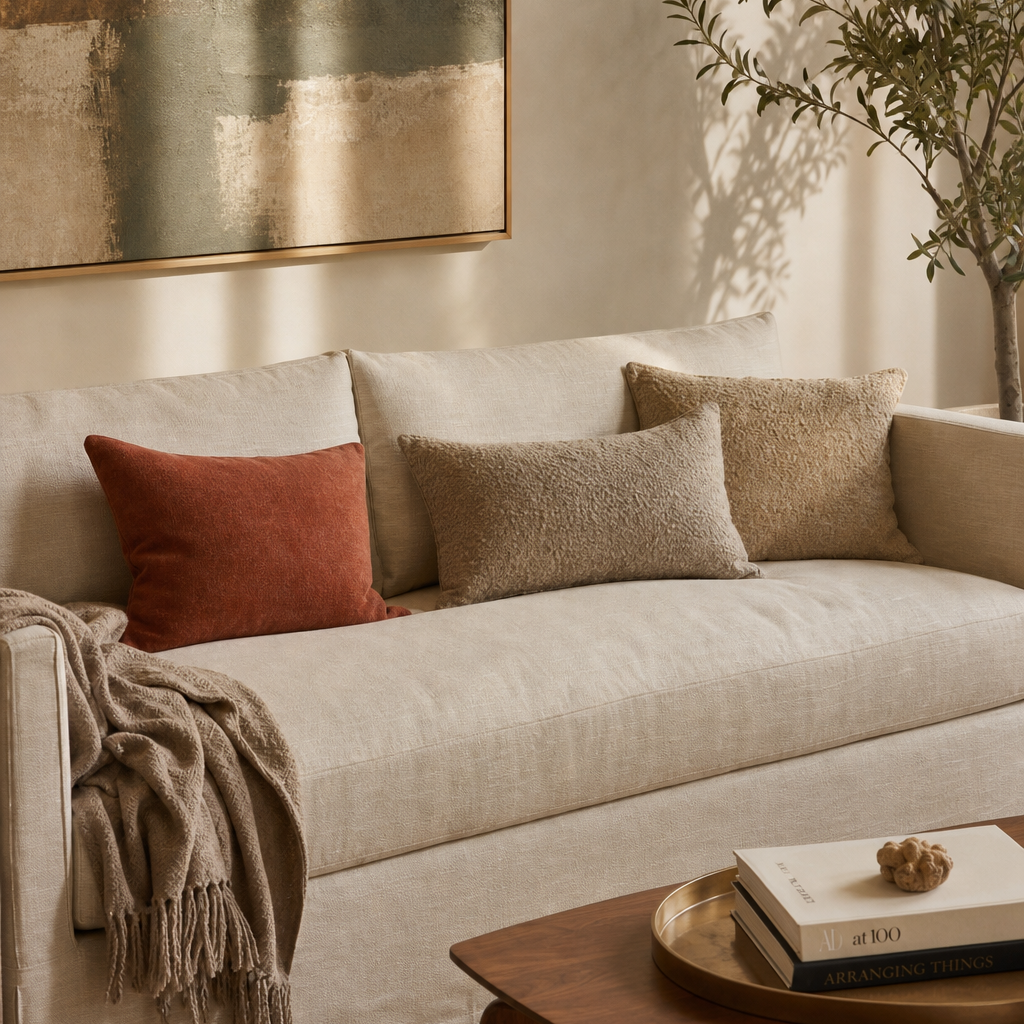
You do not need all of these. You need enough of them to create layering. A jute rug under a wood coffee table next to a linen sofa already reads as warm and considered. The combination of materials is what creates the feeling, not any single piece.
Color: Bold Moments on a Neutral Base
The mistake most people make with Latin-inspired color is going too far too fast. Saturated color works in these spaces because it appears against a restrained backdrop, not because every surface is competing for attention.
Keep walls warm white or sand. Then bring in one or two bold moments: a rug in deep terracotta or olive, a single accent chair in a vivid color, or a large-scale art print that anchors the room. The neutral base makes the bold moment feel intentional rather than chaotic. This is the same principle the NKBA's 2024 report identifies as the dominant color approach among professional designers.
Cultural Expression Through Art and Objects
The design team behind La Casita was explicit about this: the goal was emotional resonance, not surface-level tropical motifs. The architecture references personal memory, landscape, and music through material and spatial sequence. That is what makes it feel authentic rather than themed.
For your home, this means choosing art and objects that mean something to you rather than reaching for generic decor. Album art, photography by artists from the region, handmade ceramics from local markets, vinyl displayed as objects, instruments, travel pieces: these create cultural specificity without cliche. A single large-format print by a Latinx artist does more for a room than a shelf of themed merchandise.
Emotional Architecture: Building Rooms That Feel Like You
Emotional architecture is a design philosophy that aims to trigger memories, feelings, and cultural associations through form, light, material, and spatial sequence. This concept is central to understanding what makes Bad Bunny's Puerto Rico spaces feel different from a generic luxury home.
The design of La Casita was built around the island's topography, the textures of Puerto Rican vernacular building, and the social rhythms of Caribbean life. The result is a space that feels rooted rather than imported. A Puerto Rican architectural analysis described the project as one that moved mountains (literally, in terms of site work) to create something that felt genuinely of its place.
For homeowners, this is the most important concept in the entire guide. The goal is not to copy a look. It is to build spaces that feel like you.
How to Apply Emotional Architecture Without a Design Team
You do not need an architect or a celebrity budget to apply this principle. You need to make deliberate choices about what goes into your rooms and why.
Ask yourself three questions before buying any significant piece:
- Does this object have a story, or am I buying it because it looks like something I saved on Pinterest?
- Does this material or texture connect to something I actually care about, or is it just the "right" aesthetic choice?
- Does this arrangement serve the way I actually live in this room, or the way I imagine living in it?
Rooms that answer these questions honestly tend to feel personal and considered. Rooms that do not tend to feel assembled.
Indoor-Outdoor Living: Extending the Space Beyond Four Walls
One of the most consistent features of Bad Bunny's Puerto Rico spaces is the relationship between interior and exterior. Caribbean and Latin American modern architecture has always prioritized this connection, using large openings, terraces, and consistent materials to blur the boundary between inside and out.
The American Institute of Architects reported in its 2023 Home Design Trends Survey that a majority of residential architects continued to see strong client interest in outdoor living spaces, including covered outdoor rooms and outdoor kitchens. This is not a niche preference. It is a mainstream priority.
Creating Indoor-Outdoor Continuity in Any Home
You do not need a terrace or a tropical climate to apply this principle. The goal is continuity: making the transition between inside and outside feel intentional rather than abrupt.
Practical moves:
- Use the same or similar color palette inside and out. If your interior has warm neutrals and wood tones, carry those into outdoor furniture and planters.
- Place plants near thresholds, windows, and doorways. This softens the boundary visually and brings the exterior in.
- If you have a balcony, patio, or even a fire escape, treat it as a room. A small table, two chairs, and a plant arrangement create a social zone that extends your living space.
- Align sightlines where possible. A dining table positioned to look through a glass door toward an outdoor eating area creates a sense of spatial continuity even when the door is closed.
Biophilic Design on a Practical Budget
Biophilic design integrates natural elements (plants, daylight, views, and natural materials) into interiors to support wellbeing. In Bad Bunny's spaces, this shows up as large windows that frame views, plants positioned throughout rooms, and materials that reference the natural landscape.
You can apply this without renovation. Large-leaf plants (monstera, fiddle-leaf fig, bird of paradise) in simple ceramic or concrete planters add scale and life to a room. Positioning furniture to take advantage of natural light rather than fighting it costs nothing. Choosing natural materials over synthetic ones is often a matter of selection rather than budget.
The High-Low Mix: Achieving the Look on a Real Budget
Spend where it shows. Save where it does not. This is the entire strategy, and it is grounded in how design-conscious consumers actually shop. A McKinsey analysis of the home and decor market found that consumers increasingly mix high and low purchases, investing in a few statement pieces while economizing on accessories. This is not a compromise. It is a strategy.
Where to Invest
These are the pieces that carry the room visually and physically. Compromising here usually means replacing them sooner or living with something that undermines the rest of the space.
Sofa. The anchor of any living room. A well-proportioned sofa in a quality fabric (linen, bouclé, performance velvet) reads as considered even in a budget room. West Elm, Article, and Interior Define offer strong options in the mid-range.
Rug. The piece that defines the zone and sets the material tone. A natural fiber rug (jute, wool, sisal) from Lulu and Georgia or Crate and Barrel does more for a room than almost any other single purchase.
Lighting. A statement pendant or floor lamp elevates a room immediately. Rejuvenation and Anthropologie Home offer pieces with genuine design quality at prices well below luxury showrooms.
Where to Save
CategoryStrategyWhere to LookThrow pillows and blanketsBuy fewer, better ones. Easy to swap.CB2, Anthropologie HomeSide tablesClean, simple forms work as supporting pieces.CB2, IKEAArtPrints from independent artists, simply framed.Etsy, Society6Accent chairsOne quality piece; skip the matching set.Chairish, CB2
For help translating a specific inspiration image into a shoppable room concept, First Chair lets you upload photos of spaces you love and generates curated recommendations using real, in-stock furniture from retailers like West Elm, CB2, Crate and Barrel, and Lulu and Georgia. The platform is built specifically for the gap between inspiration and execution, helping you identify which two or three pieces will carry the room before you spend anything.
For more on navigating furniture buying decisions without overspending, the approach is always the same: identify the pieces that carry the room and invest there first.
Smart Home Technology: Invisible Integration
Luxury technology in residential design is felt rather than seen. The Consumer Technology Association reported that about 41% of U.S. households owned a smart speaker and around 30% owned smart lighting products, indicating that the infrastructure for this approach is already mainstream. The high-end version of smart home integration is not about visible gadgets. It is about systems that disappear into the architecture.
Practical Smart Home Upgrades for This Aesthetic
You do not need a full home automation system. A few targeted upgrades create a significant shift in how a space feels and functions.
- Lighting control. Smart bulbs (Philips Hue, a connected lighting brand by Signify, or LIFX) allow you to shift from bright daytime light to warm, dim evening ambience without changing fixtures. This single upgrade transforms how a room feels after dark.
- Audio. A compact smart speaker positioned out of sightlines, or a low-profile soundbar integrated into a media cabinet, provides music without visual clutter.
- Dimmer switches. If you are not ready for smart bulbs, replacing standard switches with dimmers is a low-cost upgrade that immediately adds flexibility and warmth to any room.
- Concealed cables and routers. Cable management and router placement are unglamorous but high-impact. A room with visible cables and a router on a shelf reads as unfinished regardless of how good the furniture is.
The goal is a space where the technology serves the experience rather than announcing itself.
Tools and Solutions for Recreating This Aesthetic
The following categories cover the tools most useful for planning, sourcing, and executing a Bad Bunny-inspired interior at a real-world budget.
Design Inspiration and Planning Platforms
Pinterest is the dominant tool for collecting and organizing visual references. Its value is in aggregation; the challenge is that it generates inspiration without execution guidance.
Houzz combines inspiration photos with product links and professional directories, making it useful for research and contractor discovery.
First Chair is an AI-assisted design and shopping platform built specifically for the gap between inspiration and execution. Upload a photo of a space you love, describe your aesthetic direction ("warm minimalist," "Latin-coastal," "Scandi but warmer"), and the platform generates curated room concepts using real, in-stock furniture from West Elm, CB2, Crate and Barrel, Pottery Barn, and Lulu and Georgia. Unlike tools that generate fantasy renders, every recommendation is buyable. First Chair also offers insider pricing on selected pieces, without the promo-code hunt. It is the most direct path from a saved Bad Bunny home photo to a shoppable room plan.
3D Layout and Visualization Tools
RoomSketcher is a consumer-friendly floor-plan and 3D visualization tool for planning furniture layouts and finishes before committing to purchases.
SketchUp is popular among architects and advanced DIY homeowners for 3D layout and massing of rooms or entire homes.
IKEA Kreativ is a free tool for visualizing layouts with IKEA products, useful as a starting point for high-low mixing.
Smart Home Ecosystems
Apple Home (HomeKit) emphasizes privacy and tight integration with Apple devices, often used in higher-end minimalist homes where visible tech is minimized.
Google Home integrates with a wide variety of devices and supports voice control of lighting, HVAC, and media.
Amazon Alexa supports smart speakers, lighting, and plugs; often a starting point in mainstream smart-home setups.
Lighting and Ambience Solutions
Philips Hue (by Signify) offers color-changing and tunable-white smart bulbs and fixtures to shift mood and highlight art or architectural features.
Lutron provides higher-end dimming and control systems for integrated, nearly invisible lighting control in luxury-style interiors.
LIFX offers Wi-Fi smart bulbs with strong color output, useful for accent lighting without rewiring.
Furniture and Decor (High-Low Mix)
West Elm offers mid-priced modern furniture with wood, brass, and bouclé textures aligned with soft-modern aesthetics.
CB2 carries contemporary, often sculptural pieces that echo the bold forms seen in celebrity homes at more accessible prices.
Article provides direct-to-consumer modern furniture with strong material quality at mid-range prices.
Latin-Inspired and Artisanal Decor
Etsy is a marketplace for independent makers offering Latin-inspired art, textiles, and ceramics, enabling culturally specific touches at accessible prices.
Chairish carries vintage and pre-owned pieces with genuine character, useful for the "collected" feeling that distinguishes intentional rooms from showroom-matched ones.
Local artisan markets (Latin American and Caribbean) provide the handmade ceramics, textiles, and wood objects that create authentic cultural specificity. These cannot be replicated by mass-market sources.
Best Practices for Recreating This Aesthetic
These practices are grounded in the design logic of Bad Bunny's spaces and in broader residential design research.
- Design the living room around conversation, not the screen. Float sofas away from walls, position them face-to-face, and treat the coffee table as the room's anchor. The TV moves to a secondary position.
- Use a restrained backdrop with a few bold moments. Keep walls warm white or sand. Bring in energy through art, a rug, or a single accent piece in a saturated color. The neutral base makes the bold moment land.
- Layer natural materials for warmth and authenticity. Mix a simple sofa with a jute rug, wood coffee table, and woven lighting. The combination of materials creates the feeling, not any single piece.
- Create indoor-outdoor continuity. Use consistent color palettes inside and out. Add plants near thresholds. Treat any outdoor space, however small, as a room.
- Express cultural identity through art and objects, not merchandise. Choose pieces that mean something to you. Album art, photography by artists from the region, handmade objects, and vinyl displayed as decor create specificity without cliche.
- Invest in lighting as a design tool. Combine ambient, task, and accent lighting. Smart bulbs that shift from bright daytime to warm evening ambience are the single highest-impact upgrade for most rooms.
- Apply the high-low mix deliberately. Identify the two or three pieces that carry the room (sofa, rug, lighting) and invest there. Economize on accessories and accent pieces that are easy to swap.
- Integrate technology so it disappears. Concealed cables, compact speakers, and app-controlled lighting serve the experience without announcing themselves.
Common Mistakes That Undermine This Aesthetic
Letting the TV Run the Room
When the television becomes the focal point, sofas push against walls and the room loses its social function. Every design decision becomes secondary to screen placement. Treat the TV as a secondary element: on a side wall, inside a cabinet, or in a separate media room if the space allows.
Over-Theming with Fandom Decor
There is a market for Bad Bunny-branded home merchandise, and it is not what this guide is about. Heavily themed spaces date quickly and tend to feel more like shrines than homes. Echo the color palettes, mood, and spatial logic of his spaces rather than filling rooms with literal references.
Confusing Minimalism with Emptiness
Minimalism works because of intentional pieces, views, and textures, not because rooms are bare. A minimal room still needs enough seating, soft surfaces, and lighting to function. Removing furniture to look minimal without replacing it with something intentional just creates a room that feels unfinished.
Ignoring Acoustics in Open-Plan Spaces
Open layouts with hard surfaces create echo and poor sound quality. This matters especially if you entertain or listen to music. Rugs, curtains, upholstered seating, and bookshelves all absorb sound. A room that looks right but sounds hollow undermines the experience.
Using Too Many Competing Colors
Latin-inspired design can be vibrant, but successful spaces anchor bold elements with a consistent base palette. Choose one or two dominant accent colors and let the rest of the room recede. The bold moment lands harder when the backdrop is quiet.
Buying Pieces Without a Layout Plan
Purchasing furniture before you have resolved the layout is the most expensive mistake in home design. Scale, proportion, and arrangement determine whether a room works. A beautiful sofa in the wrong position undermines everything around it. Resolve the layout first, then shop.
Skipping the Rug
The rug is the piece that defines the zone, sets the material tone, and ties the seating arrangement together. Rooms without rugs tend to feel unresolved regardless of how good the furniture is. If you are working with a limited budget, the rug is one of the two or three pieces worth investing in.
Room-by-Room Action Plan
Living Room
Start with the layout. Move the sofa away from the wall and position it to face another seating piece. Add a low coffee table at the center. If the TV is on the main wall, consider relocating it. Then layer in natural materials: a jute or wool rug, a wood coffee table, linen or bouclé upholstery. Add one bold moment through art or a single accent piece in a saturated color.
For help translating a specific inspiration image into a shoppable room concept, First Chair lets you upload a photo and generates curated recommendations using real, in-stock pieces from multiple retailers. It is built for exactly this moment: when you know what you want but cannot close the gap between the image and the actual room.
Bedroom
Apply the same material logic: warm woods, natural textiles, layered lighting. A linen duvet, a wood or rattan bedside table, and a simple pendant or wall sconce replace the overhead light as the primary source. Keep surfaces clear. One or two meaningful objects on a nightstand reads as intentional. A shelf of accumulated items reads as unresolved.
Outdoor Space
Even a small balcony or patio can become a social zone. Two chairs, a small table, a plant or two, and consistent materials with the interior create continuity. Treat it as a room, not a storage area.
For more on decorating a new apartment from scratch, the same principles apply at any scale. Cohesion over accumulation. Layout before shopping. A few strong pieces over many weak ones.
Frequently Asked Questions
What is the main design style of Bad Bunny's homes?
Bad Bunny's residences primarily reflect warm minimalism, a style that combines clean modern lines with tactile natural materials and muted color palettes. His Hollywood Hills home emphasizes restraint and light, while his Puerto Rico spaces draw on Caribbean vernacular architecture and emotional design principles rooted in cultural identity. The connecting thread across all his spaces is intentionality: nothing feels accidental or algorithmically assembled.
How can I recreate a celebrity home aesthetic on a limited budget?
The most effective approach is the high-low mix: invest in two or three anchor pieces (sofa, rug, lighting) that carry the room visually, and economize on accessories and accent pieces. Platforms like First Chair can help identify which pieces to prioritize across multiple retailers, so you spend where it matters and save where it does not.
What is a conversation-centric furniture layout?
A conversation-centric layout arranges seating to face other seating rather than a television or screen. Sofas and chairs are positioned around a central coffee table, creating a social zone oriented toward people. This is the layout used in Bad Bunny's no-TV living room and is widely cited by designers as more functional for entertaining and daily living than screen-oriented arrangements.
How do I incorporate Latin-inspired design without it feeling cliched?
Focus on materials, spatial logic, and meaningful objects rather than themed merchandise or generic tropical motifs. Natural materials (rattan, warm wood, handmade ceramics), art by Latin American and Caribbean artists, and a social spatial arrangement all reference the aesthetic authentically. The design team behind La Casita specifically emphasized emotional resonance over surface-level motifs.
What smart home upgrades make the biggest difference in a luxury-style interior?
Smart lighting is the highest-impact upgrade for most homes. The ability to shift from bright daytime light to warm, dim evening ambience transforms how a room feels after dark without changing any furniture or finishes. Dimmer switches are the lowest-cost version of this upgrade. Smart bulbs from Philips Hue or LIFX are the next step, offering color temperature control and app-based scene setting.
Do I need to eliminate my TV to get this look?
No. The goal is to stop letting the TV dictate the furniture arrangement. Move it to a side wall or into a cabinet so it becomes a secondary element rather than the room's focal point. The conversation-centric layout works with a television in the room; it just treats the TV as one element among many rather than the organizing principle of the entire space.
Conclusion
The design logic behind Bad Bunny's homes is not complicated, and it is not exclusive to celebrity budgets. Warm minimalism, conversation-first layouts, natural materials, cultural specificity through art and objects, and technology that disappears into the architecture: these are principles, not price points. They work in a Hollywood Hills compound and in a one-bedroom apartment in Atlanta.
The gap between the room you have saved and the room you actually live in is almost always a gap between inspiration and execution, not a gap in taste. You already know what you want the room to feel like. The work is making deliberate moves to get there.
If you are ready to close that gap, First Chair lets you upload the spaces you love and generates curated room concepts using real, in-stock furniture from West Elm, CB2, Crate and Barrel, Pottery Barn, and Lulu and Georgia. Every recommendation is buyable. Every piece is chosen to work with the others. It is the fastest path from a saved photo to a room you can actually live in.