If you've spent any time looking at luxury real estate in South Florida, you already know that Jupiter Island operates by its own logic. The properties there aren't homes in the conventional sense. They're compounds: collections of purpose-built structures organized around a specific way of living, not a single oversized house trying to do everything at once.
Tiger Woods' Jupiter Island estate is the clearest expression of that philosophy at residential scale. The property sits on roughly 12 acres and was reportedly purchased for $44.5 million in 2007. What makes it architecturally interesting isn't the price. It's the organization: a main living structure of approximately 3,300 square feet, a separate 6,400-square-foot multipurpose building for gym and recovery use, a guesthouse, a 100-foot swimming pool, a four-hole golf practice area, a wine cellar, a private cinema, and a glass-covered walkway connecting the structures. The main house is notably modest relative to the total compound footprint. That detail is the whole point.
The design intelligence here isn't in any single room. It's in the separation of functions, the creation of genuine privacy, and the commitment to supporting daily performance and recovery at a level most residential design never attempts. Those principles don't require 12 acres or $44 million. They require a different way of thinking about what a home is supposed to do.
This guide translates the underlying design logic of the Jupiter Island estate into practical renovation decisions for affluent homeowners. You'll learn:
- How compound-style program zoning applies to properties of any size
- What a genuine wellness suite requires versus a standard primary bathroom
- How smart-home automation works best when it disappears into the architecture
- Which outdoor living investments deliver the most functional return
- How to build a coordinated material palette across a large home
- Where to prioritize renovation budget before any cosmetic work begins
Key Takeaways
- The Jupiter Island estate's main living quarters are reportedly around 3,300 square feet, with a separate 6,400-square-foot multipurpose building. The design intelligence is in the separation of functions, not the total square footage.
- Program zoning, the practice of separating entertaining, wellness, and sleeping areas into distinct spatial zones, is the most transferable principle from celebrity estate design to standard luxury renovation.
- A dedicated wellness suite (gym, steam, sauna, massage, or quiet room) improves daily livability more than most decorative upgrades at a comparable budget.
- Heating and cooling account for roughly 50 percent of home energy use, which makes the building envelope the highest-leverage investment before any cosmetic work begins.
- Smart-home automation works best when it disappears. Concealed speakers, scene lighting, and app-based climate control outperform visible technology installations in both usability and resale value.
- The most common mistake in celebrity-inspired renovation is copying the amenity literally rather than translating the underlying principle. A golf simulator room delivers meaningful practice utility at a fraction of the cost and footprint of a private course.
- A coordinated material palette using one primary stone, one wood tone, and one or two metal finishes across the entire home is what separates an estate that feels considered from one that feels assembled.
Compound Living: The Design Philosophy Behind the Estate

Compound-style residence design is the practice of organizing a property into multiple buildings or distinct zones, such as a main house, guesthouse, gym pavilion, and recreation area, rather than consolidating every function under one roof. The model prioritizes privacy, functional separation, and the ability to host without disrupting the household's daily rhythms.
The Jupiter Island estate illustrates this at its most developed. The glass-covered walkway connecting the main house to the multipurpose building is not a decorative gesture. It's a functional circulation solution that maintains indoor-outdoor continuity while keeping the structures physically and acoustically separate. The entertaining areas can operate independently from the bedroom and wellness wing. Guests can move through the property without passing through private zones.
Why This Model Is Gaining Ground Among Affluent Buyers
The compound model reflects a broader shift in how high-net-worth buyers think about residential function. The demand is increasingly for privacy, self-contained amenity packages, wellness infrastructure, and personalized spatial organization rather than showpiece scale alone. A large single structure that tries to accommodate gym, theater, guest rooms, and primary living in one envelope almost always compromises at least one of those functions.
The practical consequence is that a 3,300-square-foot main house with a separate 6,400-square-foot support building often outperforms a single 9,700-square-foot structure in daily usability, acoustic separation, and long-term flexibility.
How to Apply Compound Thinking to a Single Property
Most homeowners aren't working with 12 acres. The zoning logic scales down cleanly regardless.
- Treat a detached garage or pool house as a genuine second building with its own program: gym, studio, guest suite, or media room
- Use covered outdoor corridors, pergolas, or breezeway structures to connect zones without fully enclosing them
- Design the main house so the entertaining wing (kitchen, dining, living, outdoor terrace) can operate independently from the bedroom and wellness wing
- Plan acoustic separation between high-activity zones (home theater, gym, kitchen) and quiet zones (primary suite, home office, guest rooms)
The goal is a home that feels coordinated rather than compartmentalized. Every zone should share a material language even when the functions are completely different.
Why Program Zoning Matters Now
Program zoning is the architectural practice of separating functions into distinct spatial areas to improve flow, privacy, and daily usability. In the Tiger Woods estate model, the gym and recovery spaces don't occupy a basement corner. They occupy a dedicated building designed specifically for that purpose.
For a renovation project, the equivalent move is committing real square footage to wellness, entertainment, and hospitality rather than treating them as secondary uses of leftover space. A gym that shares a room with storage will never function as well as one designed from the floor plan outward.
The wellness zoning trend in high-end renovation reflects a genuine shift in how affluent homeowners use their properties. Recovery-centered and multi-use rooms, including gym, steam, massage, hydrotherapy, and quiet sleep spaces, have become standard features in luxury renovation because they serve both daily livability and long-term resale positioning. The expensive part of the Tiger Woods model isn't the golf course. It's the underlying idea of creating a home that supports performance, rest, and entertaining in separate but coordinated zones.
For homeowners working through the furniture buying guide stage of a renovation, the zoning decisions made at the architectural level directly determine which furniture selections will actually work. A room designed for a single purpose is easier to furnish with intention than a room trying to serve three.
Luxury Kitchen and Bathroom Design: Concealed Utility, Visible Quality
High-end kitchen and bathroom design in estates at this tier follows a consistent principle: the mechanical complexity disappears, and the material quality becomes the focal point.
Sub-Zero, Wolf, and Miele appliance suites are the standard reference point because they are designed to integrate flush with cabinetry, reducing visual noise while delivering professional-grade performance. The same logic applies to bathrooms. Steam showers, radiant floor heating, and integrated lighting are not luxury add-ons at this renovation tier. They are baseline expectations, and they work best when the infrastructure is planned during the rough-in phase rather than retrofitted later.
Kitchen Design Principles for Large Homes
The following table outlines the key design decisions that separate a high-end kitchen from a standard renovation at a similar price point.
Design ElementStandard RenovationHigh-End ExecutionAppliance integrationFreestanding or semi-integratedFully flush panel-ready cabinetryRefrigerationSingle unitColumn refrigerator and freezer, separate wine storageVentilationStandard range hoodConcealed or integrated downdraft systemLightingRecessed cansLayered: ambient, task, accent, and under-cabinetIsland functionPrep and seatingPrep, seating, secondary sink, and integrated storageMaterial paletteTwo or three finishesCoordinated across countertop, cabinet, hardware, and flooring
Bathroom and Wellness Suite Renovation
A wellness suite is a dedicated home zone for exercise, recovery, stretching, steam, sauna, or other restoration activities. In the Jupiter Island compound model, this function occupies a significant portion of the 6,400-square-foot multipurpose building.
For a residential renovation, the practical translation is a primary bathroom designed as a recovery space first and a utility room second. That means:
- Steam shower with bench seating and chromotherapy lighting
- Radiant floor heating throughout
- Separate soaking tub positioned for natural light or a view
- Integrated audio (Sonos or equivalent) with moisture-rated speakers
- Towel warming and heated mirror to reduce condensation
The material palette should feel warm and grounded: large-format stone, warm wood accents, matte fixtures in aged brass or brushed nickel, and minimal grout lines where possible.
Smart Home Technology Integration for Luxury Residences
Smart-home automation is the integrated control of lighting, HVAC, security, shading, audio, and scene programming through unified interfaces including apps, wall keypads, or voice systems. The key distinction in a well-executed luxury installation is that the technology is invisible. Speakers are in-ceiling. Keypads are flush-mounted. Climate zones respond to occupancy without manual adjustment.
Control4, Crestron, and Savant are the three platforms most commonly specified in high-end residential projects. Each supports whole-home integration across lighting (Lutron is the standard pairing), HVAC, security cameras, door locks, shading, and audio-video systems. The choice between them typically comes down to the integrator's expertise and the homeowner's preference for interface complexity.
Lighting Design: The Highest-ROI Smart Investment
Layered lighting design uses ambient, task, and accent circuits independently so rooms can shift from bright and functional to calm and atmospheric without a single overhead fixture doing all the work. Lutron's Ketra system adds tunable white capability, which adjusts color temperature throughout the day to support circadian rhythms. In a wellness-focused home, this is not a novelty feature. It has measurable effects on sleep quality and daytime alertness.
The practical installation sequence:
- Plan lighting circuits during rough-in, not after drywall
- Specify dimmer-compatible fixtures throughout
- Install Lutron or equivalent dimming infrastructure before selecting fixtures
- Layer: ambient (recessed or cove), task (pendants, under-cabinet), accent (art lighting, toe-kick, landscape)
- Program scenes for morning, daytime, entertaining, and evening
Avoiding Automation Overcomplication
The most common smart-home mistake in luxury renovations is specifying more automation than the household can reliably operate. Systems that require a technician to adjust basic functions, or that confuse guests, defeat the purpose entirely.
The rule: automate the repetitive and invisible (HVAC scheduling, irrigation, security monitoring, lighting scenes) and keep manual control available for everything else. A well-programmed Lutron keypad with four scene buttons is more useful than a 12-screen tablet interface that nobody uses correctly.
Outdoor Living Spaces: Pools, Patios, and Landscaped Privacy
The 100-foot pool at the Jupiter Island estate is not primarily a recreational amenity. It functions as a lap and training pool, which changes how it's designed: the proportions prioritize length over width, the finish is typically a darker plaster or aggregate for reduced glare, and the surrounding hardscape is designed for function rather than lounge aesthetics.
For homeowners translating this into a realistic outdoor living investment, the principle is designing the pool and surrounding landscape as a unified outdoor room rather than a water feature surrounded by leftover space.
Pool Design for Performance and Aesthetics
Pentair and Hayward are the dominant automation platforms for residential pools at this tier. Both support app-based control of temperature, lighting, filtration cycles, and water chemistry monitoring. The practical benefit is that a pool at the right temperature with clean water and working lighting gets used consistently. A pool that requires manual adjustment before every swim does not.
Key design decisions for a high-end pool installation:
Design ElementStandard InstallationHigh-End ExecutionFinishWhite plasterDark plaster, pebble aggregate, or glass tileLength20-30 feet40-60 feet minimum for lap swimmingAutomationManual or basic timerFull Pentair or Hayward integrationSurround materialConcrete or paversLarge-format porcelain, travertine, or sealed concreteShade structureUmbrella or nonePergola, sail shade, or covered loggia
Landscape as Architecture
The Jupiter Island property uses its 12-acre site to create complete visual privacy from neighboring properties and the road. For most homeowners, the equivalent investment is a thoughtful privacy planting plan combined with a perimeter fence or wall system that uses the same materials as the house exterior.
Landscape design at this level treats trees, hedges, grade changes, and hardscape as architectural elements rather than decorative afterthoughts. The circulation path from the motor court to the front entry, from the kitchen to the outdoor dining area, and from the primary suite to the pool should all be planned with the same intentionality as interior floor plan circulation.
The practice facility on the Jupiter Island estate reportedly uses brackish water pumped from more than 1,200 feet deep and treated through reverse osmosis for irrigation. That level of water engineering isn't realistic for most properties, but the underlying principle of designing irrigation systems around non-potable or reclaimed water sources is increasingly relevant in water-stressed markets and coastal climates.
Golf Course Home Design and Purpose-Built Recreation Amenities
The four-hole practice golf course at the Jupiter Island estate is the most-cited feature in coverage of the property, and also the least transferable. A private golf course requires acreage, irrigation infrastructure, maintenance staff, and ongoing operating costs that place it firmly outside the scope of residential renovation for most buyers.
The design principle behind it is entirely transferable: dedicate a portion of the property to a purpose-built recreation amenity that supports the owner's primary athletic or leisure interest.
Realistic Translations of the Golf Course Concept
The table below maps celebrity-scale amenities to their underlying design principles and realistic residential equivalents.
Celebrity AmenityUnderlying PrincipleRealistic Residential TranslationFour-hole golf coursePurpose-built athletic practice spacePutting green, chipping area, or golf simulator room100-foot lap poolTraining-grade aquatic facility40-60 foot lap pool with full automation6,400 sq ft gym buildingDedicated wellness and recovery zone400-800 sq ft home gym with steam and recovery areaPrivate cinemaDedicated entertainment zoneMedia room with acoustic treatmentGuesthouseHospitality zoning separate from main houseDetached ADU, pool house, or guest suite with private entry
A golf simulator room delivers a meaningful fraction of the practice utility of a real course at a fraction of the cost and footprint. High-end simulator systems from Full Swing or Trackman, paired with a properly sized room (minimum 10 feet of ceiling height and 15 feet of depth), create a genuinely useful training environment that also functions as an entertainment space for guests.
Contemporary Interior Design for Large Homes: Cohesion Over Scale
Large homes fail aesthetically for one consistent reason: the interior design tries to fill the space rather than organize it. Oversized furniture, too many competing finishes, and rooms that feel like showroom vignettes rather than lived-in spaces are the most common outcomes of renovation projects that prioritize scale over cohesion.
Coverage of the Jupiter Island estate describes an interior that feels considered rather than maximalist. That restraint is a design choice, not a budget constraint.
Building a Coordinated Material Palette
A coordinated material palette uses a limited set of finishes across the entire home so that rooms feel connected rather than independently decorated. The standard approach for a large luxury home:
- Primary neutral: One stone or large-format tile used across multiple floors and surfaces (kitchen countertop, bathroom floor, outdoor terrace)
- Wood tone: One warm wood species or stain used across cabinetry, flooring, and millwork
- Metal finish: One or two hardware finishes used consistently (aged brass and matte black work together; brushed nickel and polished chrome do not)
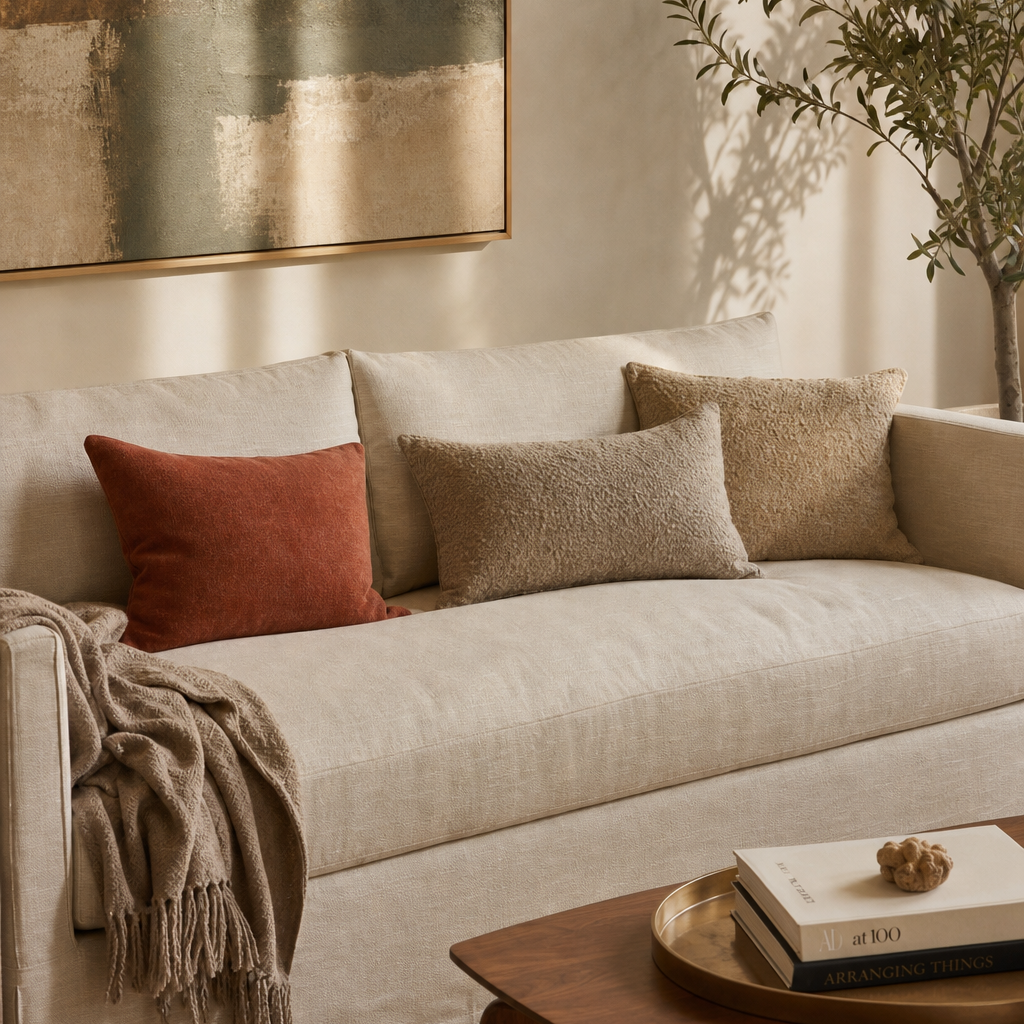
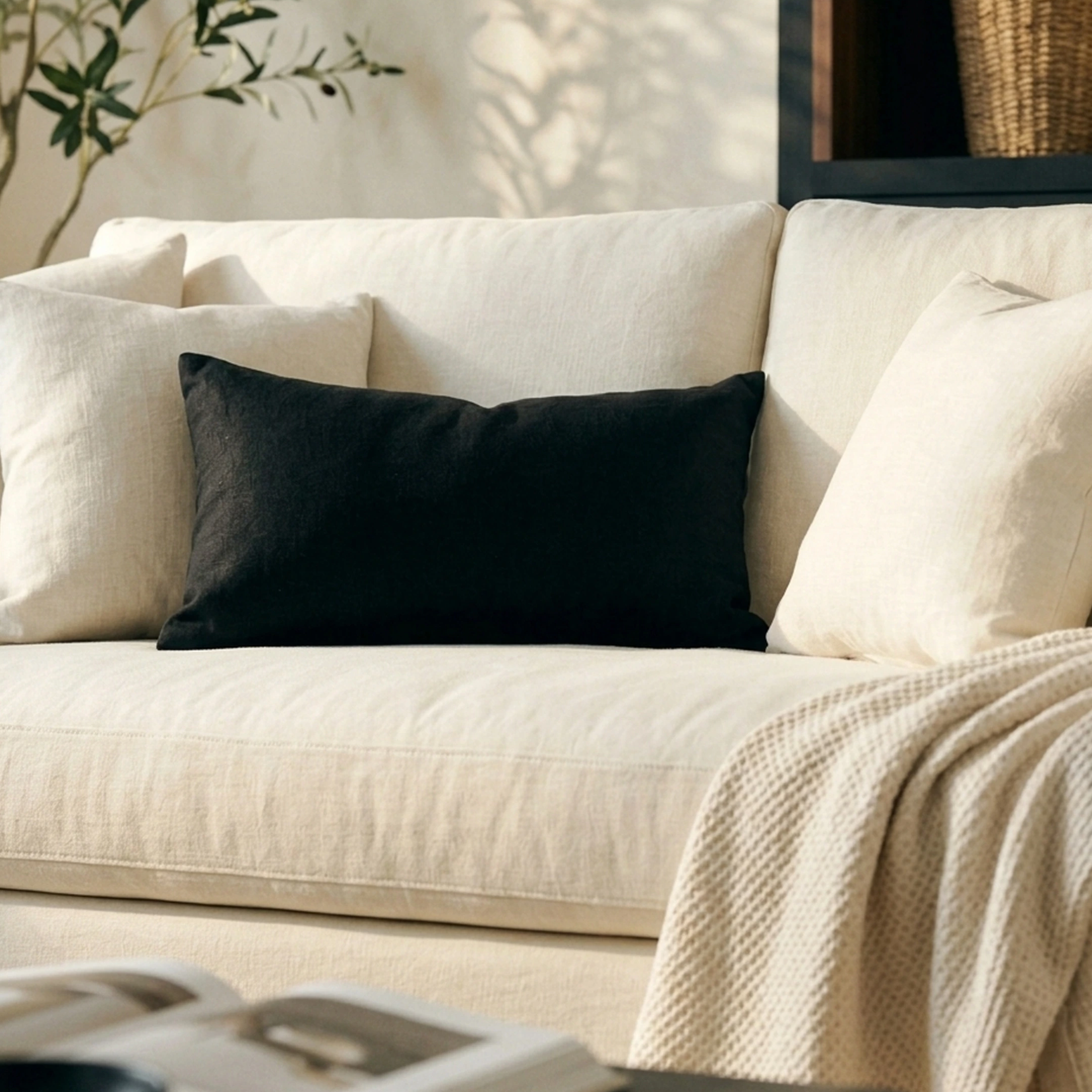
- Upholstery palette: Warm neutrals with one or two accent tones, consistent across all upholstered pieces
The goal is a home where a guest moving from the kitchen to the primary suite to the outdoor terrace feels a continuous visual logic rather than a series of disconnected rooms.
Furniture Selection for Large Rooms
Large rooms require furniture scaled to the space, but the common mistake is buying oversized pieces that fill the room rather than anchor it. The better approach is using appropriately scaled furniture with generous negative space between groupings.
For a living room in a large home, this typically means:
- A sofa in the 100-120 inch range (not a sectional that wraps the entire room)
- A coffee table that leaves 18 inches of clearance on all sides
- A rug large enough that all furniture legs sit on it
- Accent chairs positioned to create conversation groupings, not to fill corners
Pieces from RH, Restoration Hardware, or Interior Define work well at this scale because they are proportioned for larger rooms without becoming visually overwhelming. First Chair's approach to sourcing across West Elm, CB2, Crate and Barrel, Pottery Barn, and Lulu and Georgia means the interior design layer can be built around a coordinated palette rather than whatever a single retailer happens to stock. That matters when the goal is cohesion across a large home rather than filling rooms with unrelated pieces.
Sustainable Luxury: High-Performance Envelopes and Efficient Systems
The building envelope is the combination of roof, walls, windows, doors, and insulation designed to minimize air leakage and heat transfer. Investing in the envelope before cosmetic upgrades is the single highest-leverage decision in any serious renovation.
Heating and cooling account for approximately 50 percent of home energy use. ENERGY STAR certification indicates a home that is at least 10 percent more efficient than homes built to code, which translates directly to lower operating costs and improved comfort year-round.
Building Envelope Priorities
For a luxury renovation in a warm or coastal climate, the envelope priorities in order of impact:
- Air sealing at all penetrations, joints, and transitions
- Continuous insulation in walls and roof assembly
- High-performance windows (Marvin, Andersen, or Pella at the luxury tier) with low-E coatings and appropriate solar heat gain coefficients for the climate
- Impact-resistant glazing in hurricane-prone markets (required by code in many Florida counties)
- Roofing materials with high solar reflectance to reduce cooling loads
HVAC and Indoor Air Quality
Zoned HVAC systems from Carrier, Trane, or Mitsubishi Electric allow different areas of a large home to maintain independent temperature and humidity settings. In a compound-style residence, this is essential: the gym, the primary suite, the wine cellar, and the home theater all have different thermal requirements.
Humidity control is particularly important in coastal and warm climates. A dedicated whole-home dehumidification system, often integrated with the HVAC, prevents the clammy, musty feeling that undermines the experience of an otherwise well-designed home. This is one of the most commonly skipped investments in luxury renovation and one of the most regretted.
Tools and Platforms for Luxury Home Renovation
The following categories represent the core technology and product infrastructure for a renovation at this tier. Each category includes the platforms most commonly specified by architects and interior designers working on high-end residential projects.
Smart-Home Control Platforms
Control4, Crestron, and Savant are the three dominant whole-home automation platforms. Each supports integration across lighting, HVAC, security, shading, and audio-video systems. The choice between them depends primarily on the integrator's expertise and the complexity of the installation.
Lighting Systems
Lutron is the standard specification for dimming and scene control at this tier. The Ketra line adds tunable white capability for circadian-rhythm support. Lucifer Lighting and Artemide are common choices for architectural fixture specification.
HVAC and Indoor Air Quality
Carrier, Trane, and Mitsubishi Electric are the primary specifications for zoned residential HVAC. Mitsubishi's multi-split systems are particularly well-suited to compound-style properties where individual buildings require independent climate control.
Window and Facade Systems
Marvin, Andersen, and Pella are the primary luxury-tier window specifications. All three offer impact-resistant options for coastal markets and high-performance glazing packages with low-E coatings and appropriate solar heat gain coefficients.
Kitchen Appliance Suites
Sub-Zero, Wolf, and Miele are the standard specifications for panel-ready, professional-grade kitchen appliances. All three are designed for flush integration with custom cabinetry.
Outdoor Living and Pool Systems
Pentair and Hayward are the dominant pool automation platforms. Both support app-based control of temperature, chemistry, lighting, and filtration. Bullfrog Spas is a common specification for integrated spa systems.
Interior Design and Furniture Sourcing
First Chair sources across multiple retailers including West Elm, CB2, Crate and Barrel, Pottery Barn, and Lulu and Georgia to build coordinated room concepts using real, in-stock pieces. For large homes where cohesion across multiple rooms is the primary challenge, multi-retailer sourcing with a unified design direction is more effective than working from a single catalog. Member pricing is available on most pieces without the promo-code search.
Audio, Video, and Home Theater
Sonos handles distributed audio effectively for most residential applications. Savant integrates audio-video with the broader home automation system. Kaleidescape is the standard specification for cinema-grade media rooms where film quality and library management matter.
Best Practices for Luxury Home Renovation
- Invest in the envelope before the finishes. Air sealing, insulation, and high-performance windows improve comfort and operating costs more than any decorative upgrade at a comparable budget. Do this first.
- Separate public and private zones. Entertaining areas should be able to operate without disrupting bedrooms and recovery spaces. This is the most transferable principle from compound-style estate design.
- Design wellness into the floor plan. A gym, steam, sauna, or quiet room that is planned from the beginning will always outperform one that is retrofitted into leftover space.
- Use layered lighting throughout. Ambient, task, and accent circuits allow rooms to shift function without a single overhead fixture doing all the work. Plan circuits during rough-in.
- Create indoor-outdoor continuity. Large openings, covered walkways, and coordinated material palettes between interior and exterior surfaces make the outdoor living areas feel like genuine extensions of the home.
- Treat landscape as architecture. Privacy planting, grade changes, and hardscape circulation should be planned with the same intentionality as interior floor plan decisions.
- Automate the invisible, not the visible. HVAC scheduling, irrigation, security monitoring, and lighting scenes are the right targets for automation. Systems that guests can't figure out are systems that don't work.
- Limit the material palette. One primary stone, one wood tone, and one or two metal finishes across the entire home creates cohesion. More than that creates a showroom.
Common Mistakes in Celebrity-Inspired Luxury Renovation
Copying the amenity instead of the principle. A private golf course is not a realistic renovation project. A golf simulator room, a putting green, or a sport court delivers the underlying principle (a purpose-built athletic space) at a fraction of the cost. The home furnishing mistakes statistics consistently show that renovation regret comes from literal copying rather than principled translation.
Overbuilding the spectacle and underbuilding the shell. Expensive rooms that still feel hot, drafty, or noisy are the direct result of skipping envelope and HVAC investment in favor of finishes. Fix: sequence the renovation correctly, envelope first.
Using too many unrelated finishes. A home with six different stone types, four wood tones, and three metal finishes feels like a showroom rather than a coordinated estate. Fix: establish the palette before selecting any individual piece.
Ignoring zoning. Gyms, theaters, and guest areas that conflict with sleep and work functions undermine the daily livability of the home regardless of finish quality. Fix: resolve the program plan before the floor plan.
Skipping humidity and ventilation planning. In warm or coastal climates, this is the most commonly regretted omission. A whole-home dehumidification system is not optional in South Florida or similar markets. Fix: specify humidity control as part of the HVAC scope, not as an afterthought.
Overcomplicating automation. Systems that require a technician to adjust basic functions, or that household members and guests can't operate independently, defeat the purpose of the investment. Fix: automate the repetitive and invisible; keep manual control available for everything else.
Designing for image instead of daily use. Oversized features that are hard to maintain or rarely used are a consistent pattern in celebrity-inspired renovation. Fix: ask how often each feature will realistically be used before committing the budget.
Underestimating exterior drainage and irrigation. On large lots, water management is a functional design issue, not a landscaping detail. Fix: engage a civil engineer or landscape architect early in the process, not after the hardscape is installed.
Bringing It Together: A Renovation Priority Framework
The following framework organizes renovation priorities by impact and transferability from the Jupiter Island estate model.
Priority TierInvestment AreaUnderlying PrincipleTier 1: FoundationBuilding envelope, HVAC, electricalPerformance before aestheticsTier 2: ZoningProgram separation, acoustic isolationCompound thinking at any scaleTier 3: WellnessGym, steam, sauna, recovery spaceDaily performance and restorationTier 4: OutdoorPool, landscape, covered outdoor roomsIndoor-outdoor continuityTier 5: TechnologyLighting, automation, AVInvisible systems, visible qualityTier 6: AmenityGolf simulator, media room, wine cellarPurpose-built recreation at realistic scale
The sequence matters. Homeowners who start at Tier 6 and work backward consistently report more renovation regret than those who build from the foundation up. The interior design app usage statistics reflect this: design-minded homeowners are increasingly using digital tools to visualize and plan before committing to purchases, which reduces the costly mismatches that come from buying pieces in isolation.
For homeowners at the stage of translating a renovation vision into actual furniture and decor decisions, First Chair's multi-retailer sourcing means the interior design layer can be built around a coordinated palette rather than whatever a single retailer happens to stock. That matters when the goal is cohesion across a large home rather than filling rooms with unrelated pieces.
If you're working through the specific challenge of furnishing a small city apartment within a larger compound, or a guest suite that needs to feel complete without competing with the main residence, the same principles of program zoning and material continuity apply at any scale.
Frequently Asked Questions
What design features from Tiger Woods' house can homeowners realistically recreate?
The most transferable features are program zoning (separating entertaining, wellness, and sleeping areas into distinct spatial zones), layered lighting design, a dedicated wellness suite, and indoor-outdoor continuity through covered walkways or large-format glazing. The four-hole golf course and 100-foot pool are not realistic for most properties, but a golf simulator room, a 40-60 foot lap pool, and a dedicated gym with steam and recovery space deliver the underlying principles at a realistic scale.
How much does a luxury home wellness suite typically cost to build?
Costs vary significantly based on scope and market, but a dedicated gym and recovery suite with steam shower, sauna, and high-end finishes typically ranges from $150,000 to $400,000 for a 400-800 square foot space in a major U.S. market. The key investment decisions are the steam and sauna infrastructure, radiant floor heating, and acoustic separation from adjacent rooms. These are best planned during the rough-in phase rather than retrofitted later.
What smart-home platform is best for a large luxury home?
Control4, Crestron, and Savant are the three platforms most commonly specified in high-end residential projects. The right choice depends primarily on the integrator's expertise and the homeowner's preference for interface complexity. All three support whole-home integration across lighting, HVAC, security, shading, and audio-video. The more important decision is pairing any of these platforms with Lutron for lighting control, which is the standard specification at this tier regardless of which automation platform is selected.
How do you create a coordinated material palette across a large home?
The standard approach is to select one primary stone or large-format tile used across multiple surfaces (kitchen countertop, bathroom floor, outdoor terrace), one warm wood species or stain used across cabinetry, flooring, and millwork, and one or two metal finishes used consistently across all hardware. This limited palette creates visual continuity across rooms without making the home feel monotonous. The mistake is adding finishes incrementally as rooms are renovated, which produces a home that looks assembled rather than designed.
What is the most important renovation investment before cosmetic upgrades?
The building envelope: air sealing, insulation, and high-performance windows. Heating and cooling account for approximately 50 percent of home energy use, which means envelope improvements deliver more measurable impact on comfort and operating cost than any decorative upgrade at a comparable budget. In coastal and hurricane-prone markets, impact-resistant glazing is also a code requirement in many jurisdictions and a meaningful resilience investment regardless of code status.
How do you translate a celebrity estate's design principles to a smaller property?
The key is identifying the underlying principle rather than copying the amenity. A four-hole golf course represents a purpose-built athletic practice space. A golf simulator room, a putting green, or a sport court delivers that principle at a realistic scale. A 100-foot pool represents a training-grade aquatic facility. A 40-60 foot lap pool with full automation delivers the same function. The compound model represents program zoning and functional separation. A detached pool house or ADU with its own program delivers the same logic on a standard residential lot.
Conclusion
The Tiger Woods Jupiter Island estate is worth studying not because of its price or its golf course, but because of how clearly it demonstrates a principle that applies at any scale: a home organized around distinct functional zones, with real investment in wellness, performance, and daily livability, outperforms a single oversized structure trying to do everything at once.
The design moves that matter most here are not the spectacular ones. They're the sequencing decisions: envelope before finishes, zoning before furniture, palette before pieces. Get those right and the rest of the renovation follows a logic that holds together.
If you're at the stage of translating a renovation vision into actual furniture and decor decisions, turn your inspiration into a real room with First Chair. The platform sources across multiple retailers to build coordinated room concepts using pieces that actually exist, so the interior design layer reflects the same intentionality as the renovation decisions behind it.