
You've seen the Architectural Digest spread. Maybe you've watched the Open Door video three times. There's something about Jennifer Aniston's Bel Air home that stops the scroll: rooms that feel simultaneously expensive and lived-in, calm without being cold, edited without feeling sparse. It reads like someone actually thought about how each piece would feel at 7pm on a Tuesday, not just how it would photograph.
The instinct most people have is that recreating this requires a $21 million property and a team of designers. That instinct is wrong. The design principles behind her spaces are more accessible than the price tag suggests. Warm neutrals, mid-century bones, indoor-outdoor flow, and edited accessories are not budget items. They are decisions. And decisions are available to anyone willing to make them with clarity and restraint.
What makes Aniston's aesthetic particularly useful as a reference point is that it sits squarely within what McKinsey's luxury research identifies as the dominant direction in affluent residential design: quiet luxury. Not visible logos or maximalist layering, but craftsmanship, quality materials, and comfort. That orientation is achievable at multiple price points. The gap between her living room and yours is not primarily financial. It is a gap in confidence and execution.
This guide breaks down the specific design moves that define her spaces and translates each one into practical strategies for homeowners who want that same feeling of considered, quiet luxury without starting from scratch. You will learn:
- How to build a warm neutral palette that reads expensive rather than bland
- Which mid-century furniture principles age well and which date quickly
- How to plan layered lighting that shifts a room from functional to intimate
- What makes a spa bathroom feel luxurious without a full gut renovation
- How to design outdoor spaces as a series of intentional rooms
- How to curate art and accessories so a room feels collected, not accumulated
- Where smart home technology actually earns its place in a design-focused home
Key Takeaways
- Jennifer Aniston's interiors are built on warm minimalism: neutral palettes, natural materials, clean-lined furniture, and layered lighting rather than maximalist decoration.
- U.S. homeowners spent over $570 billion on home improvements in 2022, with high-income owners driving discretionary upgrades in kitchens, baths, and outdoor spaces.
- More than 70% of affluent consumers say craftsmanship and quality matter more than visible logos, which is exactly the quiet luxury orientation Aniston's spaces embody.
- Homes marketed with "spa bathroom" language sold for 1.7% more on average, and "chef's kitchen" listings sold for 1.6% more, validating the investment case for these upgrades.
- More than 75% of buyers rate a patio as essential or desirable, making outdoor living one of the highest-return design investments in warm climates.
- Recreating this aesthetic is less about budget and more about restraint: fewer pieces doing more work, one strong material per room, and lighting treated as a design element rather than an afterthought.
- The global smart lighting market is projected to reach $44.2 billion by 2029, reflecting how central lighting control has become to luxury residential design.
- Platforms like First Chair help homeowners translate inspiration photos directly into shoppable room concepts built around real, in-stock furniture from multiple retailers.
What "Quiet Luxury" Actually Means in a Residential Context
Quiet luxury in residential design is an aesthetic orientation that prioritizes quality materials, craftsmanship, and sensory comfort over visible branding, maximalist layering, or trend-driven decoration. The term describes spaces that feel expensive without announcing themselves.
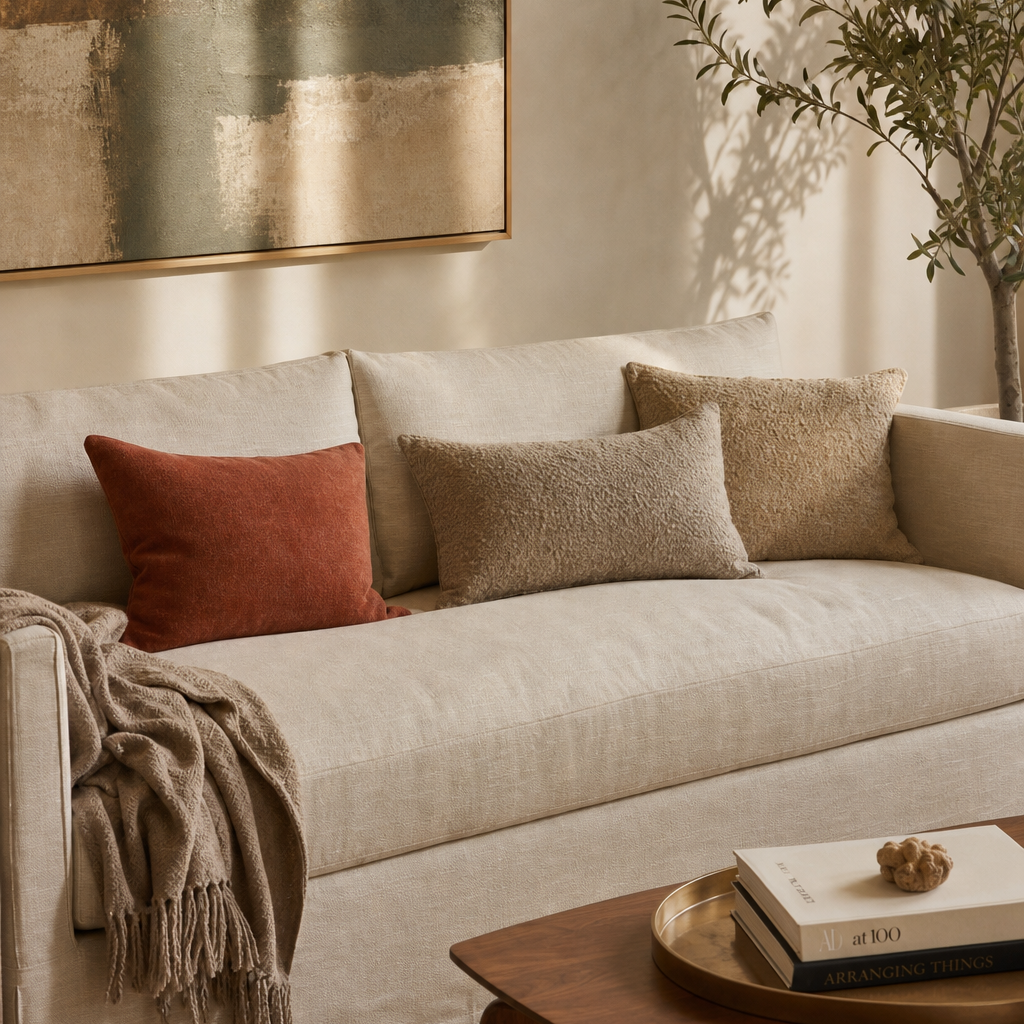
Aniston's Bel Air home, documented extensively in Architectural Digest's Open Door series, is a textbook case. Soft cream sofas. Warm wood credenzas. Stone surfaces. Abstract art with generous negative space around it. The rooms feel considered because almost nothing in them is accidental, and almost nothing is competing for attention.
This is the design principle that makes her spaces reproducible. Quiet luxury is not a function of price. It is a function of restraint and intentionality. A $400 linen sofa in the right neutral reads as quiet luxury. A $4,000 sofa in the wrong pattern does not.
Why This Aesthetic Is Dominating Affluent Home Design Right Now
Several converging forces have pushed warm minimalism and quiet luxury to the center of high-end residential design in 2026.
The financial case is clear. The Joint Center for Housing Studies of Harvard University reports that high-income owners account for more than half of total home improvement spending, with a strong focus on discretionary projects such as kitchen, bath, and outdoor upgrades. Homeowners in this segment are not just spending on comfort. They are spending on value creation.
The cultural shift is equally significant. More than 70% of affluent consumers now say craftsmanship and quality matter more than visible logos in their luxury purchases. That preference has migrated from fashion directly into residential design. Homes that once signaled status through ornate detailing and maximalist layering now signal it through restraint, natural materials, and considered editing.
The outdoor living component reflects a separate but related shift. The National Association of Home Builders finds that open-layout kitchen-family rooms and outdoor living spaces are among the most desired features in higher-price segments. Aniston's open-plan entertaining areas and resort-style terraces are not just personal preferences. They are the features that define the category.
Finally, California's regulatory environment has shaped her specific approach to landscaping. State water-use regulations and incentive programs have pushed luxury homeowners toward drought-tolerant planting schemes that still feel lush and intentional. Her garden's focus on Mediterranean and Asian water-efficient species is partly aesthetic and partly a response to real constraints, which is a useful reminder that good design often starts with working within limitations rather than ignoring them.
The Neutral Color Palette That Makes Every Room Feel Calm
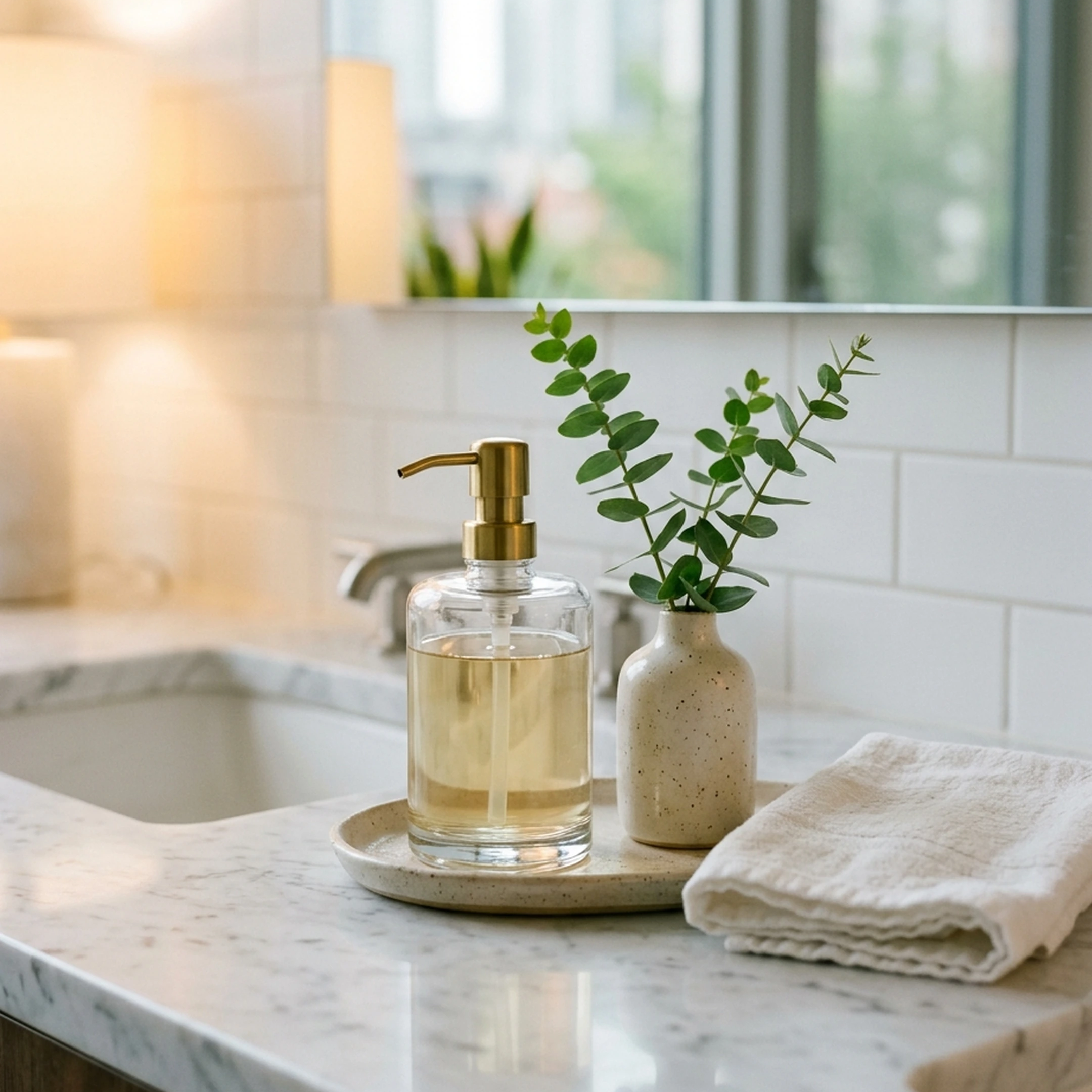
A warm neutral palette is a color strategy that layers warm whites, soft taupes, camel tones, and natural wood finishes to create depth and visual richness without introducing competing hues. It is the foundation of Aniston's interior aesthetic and the single most reproducible element of her design approach.
Her living spaces, as described in Architectural Digest's coverage, are built on soft cream sofas and white pieces with an overall subtle palette that reads as calm rather than cold. Homes and Gardens identifies her living room as a defining example of 2026 warm minimalism, specifically because the neutrals are warm rather than cool and layered rather than flat.
Choosing Your Anchor Neutral
The practical starting point is selecting one warm white for walls and one or two deeper neutrals for cabinetry, trim, or a feature wall. Benjamin Moore's White Dove and Pale Oak, Sherwin-Williams' Accessible Beige and Antique White, and Farrow and Ball's Elephant's Breath and Skimming Stone are all frequently cited by designers working in this direction.
Test large samples directly on your walls before committing. The same paint chip reads completely differently in a north-facing room versus a south-facing one. A color that looks warm and creamy in the store can look gray or yellow on your actual walls depending on the light source and the hour of day.
Building Depth Through Texture, Not Color
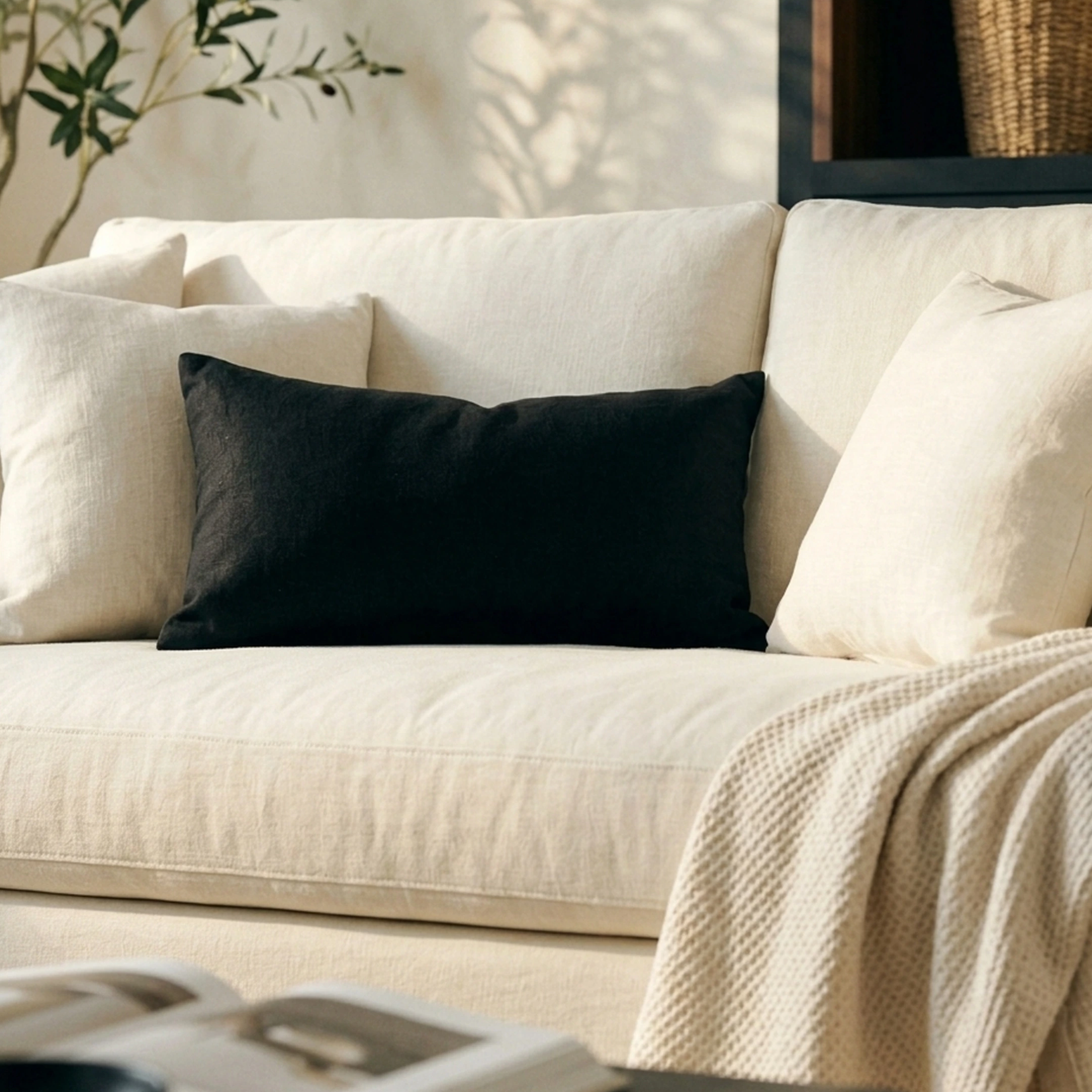
Once the wall color is settled, depth comes from texture. Aniston's rooms layer bouclé, linen, wool, and silk rugs to create visual richness without introducing competing colors. A cream sofa in a flat fabric reads flat. The same sofa in a textured weave reads considered.
The discipline is simple: if you want to add interest, reach for a different material before you reach for a different color. This single rule separates a cohesive neutral room from a boring one.
Neutral Palette Reference Guide
The table below maps each layer of a warm neutral room to the material, finish, and tone that creates the right effect.
LayerMaterial or FinishExample ToneWallsMatte paintWarm white, soft creamLarge upholsteryLinen or boucléOatmeal, ivoryArea rugsWool or silkCamel, taupeWood accentsWarm oak or walnutHoney, medium brownTextiles and throwsCotton or cashmereMushroom, sandStone surfacesMarble or limestoneWarm white, veined cream
Mid-Century Modern Furniture and Layout Strategies That Age Well
Mid-century modern is a design style from roughly the 1940s through the 1960s characterized by clean lines, organic forms, and strong indoor-outdoor connections, often featuring wood, stone, and geometric shapes. Aniston's Bel Air home is a classic mid-century structure updated with contemporary finishes, and coverage from Homes and Gardens identifies her living room as a defining example of warm minimalism built on mid-century bones.
The distinction worth making is this: mid-century modern done well looks timeless. Mid-century modern done poorly looks like a furniture catalog from a decade ago. The difference is usually in the silhouette choices and the mixing approach.
Investing in One Hero Piece Per Room
The most efficient way to anchor a room in this aesthetic is to invest in one strong mid-century-inspired piece per main space. A wood credenza in the living room. A sculptural lounge chair in the bedroom. A solid-wood dining table that does not need much else around it.
Keep silhouettes low-slung and simple. Avoid overstuffed shapes. The richness should come from the wood grain and upholstery texture, not from ornate detailing or carved legs. Room and Board and Design Within Reach both carry pieces that hold this aesthetic without requiring custom pricing.
Layout Principles for Open-Plan Spaces
The NAHB consistently identifies open-layout kitchen-family rooms as highly desired features in higher-price segments. The layout challenge in these spaces is creating definition without walls.
The practical solution is zoning through rugs, lighting, and furniture groupings rather than partitions. A large area rug defines the seating zone. A pendant light defines the dining zone. Furniture faces inward toward a focal point rather than outward toward walls. This creates the feeling of distinct rooms within a single open space.
For homeowners working through furniture decisions for smaller or open-plan spaces, the same principles apply at a reduced scale: one anchor piece, one defining rug, and a clear focal point.
Mid-Century Furniture: What Ages Well vs. What Dates Quickly
Not all mid-century references hold up equally over time. The table below distinguishes the choices that remain timeless from those that tend to feel dated.
ChoiceAges WellDates QuicklyLeg styleTapered solid wood legsHairpin legs in thin black metalUpholsteryWarm linen, wool, or leatherBright orange or avocado velvetWood finishWarm walnut or oakHigh-gloss lacquered teakScaleLow-slung, generous proportionsUltra-thin, fragile silhouettesMixingVintage with contemporaryAll-matching "mid-century sets"
High-End Lighting Fixtures and Ambient Design
Layered lighting is the practice of combining ambient, task, and accent lighting to create flexible moods and highlight architectural features. In Aniston's home, Architectural Digest notes that lighting functions as sculptural elements, with bold fixtures and unusual pendants used alongside recessed ambient sources in the vintage-style family room.
This is one of the highest-return design investments available to homeowners. The furniture can be mid-range. The lighting cannot look like an afterthought.
Planning Three Layers in Every Room
Every main room should have three distinct lighting layers working together:
- Ambient lighting: Recessed ceiling fixtures or a central pendant. Prefer warm LED at 2700 to 3000 Kelvin. This is the base layer that fills the room with general illumination.
- Task lighting: Floor lamps beside seating, pendants over dining tables, under-cabinet strips in kitchens. This layer supports specific activities without relying on overhead sources.
- Accent lighting: Picture lights over art, small table lamps on consoles, uplights behind plants. This layer creates depth and draws the eye to intentional moments.
Residential LED adoption has risen from 4% in 2015 to 47% of all residential lighting by 2020, according to the U.S. Energy Information Administration. In a renovated or newly furnished home, warm LED throughout is the baseline expectation. The color temperature matters as much as the fixture itself.
Choosing Statement Fixtures
The sculptural pendant or chandelier is where personality enters a neutral room. In a space where everything else is restrained, one strong fixture over a dining table or in an entry does significant work. Rejuvenation and Anthropologie Home both carry fixtures that read as considered without requiring custom fabrication.
For smart control, Lutron's residential dimming systems allow whole-home lighting scenes to be set and adjusted from a single interface. This is the single highest-impact smart home investment for a design-focused homeowner: the ability to shift a room from bright and functional to warm and intimate without changing a fixture.
Luxury Bathroom and Kitchen Design Ideas Worth the Investment
A spa bathroom is a residential bathroom designed with luxury materials, generous space, and wellness features such as steam showers, soaking tubs, and integrated lighting that evoke a spa environment. Hello Magazine's coverage of Aniston's $21 million mansion highlights a glass steam shower with dual heads and bench seating as a defining feature of her bathroom design.
The investment case is documented. Homes marketed with "spa bathroom" language sold for 1.7% more on average, and "chef's kitchen" listings sold for 1.6% more, according to Zillow's analysis of listing language and sale prices. These are not just aesthetic upgrades. They are value-building decisions.
Spa Bathroom Principles Without Full Custom Work
The spa bathroom aesthetic is achievable without a full gut renovation. The elements that read as luxurious are:
- Large-format stone or stone-look tile on floors and walls, ideally running floor to ceiling in the shower
- A frameless or minimal-frame glass enclosure rather than a curtain or framed door
- Warm, layered lighting including a backlit mirror and separate accent sources
- A single freestanding element, either a soaking tub or a sculptural vanity, that anchors the room
- Surfaces kept visually clean, with storage behind closed doors rather than products on display
Kohler and Hansgrohe both offer fixtures that achieve this aesthetic at a range of price points. The goal is to reduce visual clutter: fewer products visible, better storage, and surfaces that read as intentional.
Chef's Kitchen Essentials
The chef's kitchen aesthetic is less about the appliances themselves and more about the visual language. Panel-ready appliances that disappear into cabinetry. A large island with seating on one side. Open shelving used sparingly for a few considered objects rather than everything. Sub-Zero and Wolf are the reference brands in this category, but the visual effect can be approximated with integrated appliances and strong cabinetry choices at lower price points.
The single most important decision in a kitchen renovation aimed at this aesthetic is cabinetry. Clean-lined, handle-free or minimal-hardware doors in a warm white or soft sage read as considered. Ornate detailing or heavy hardware works against the quiet luxury direction immediately.
Indoor-Outdoor Living Spaces and Patio Design
Indoor-outdoor living is a design strategy that blurs the boundaries between interior and exterior spaces using large openings, consistent materials, and outdoor rooms that function as extensions of the interior. Aniston's designer reorganized her property into interconnected outdoor rooms, terraces, and Asian-inspired pocket gardens, creating a sequence of spaces that feel like a continuation of the interior rather than a separate zone.
The American Institute of Architects' Home Design Trends Survey ranks blended indoor-outdoor living among the top increasing features requested by clients, particularly in the West region. This is not a trend that is fading.
Treating Your Yard as a Series of Rooms
The most useful conceptual shift for outdoor design is treating the yard as a floor plan. A dining area. A lounge area. A quiet reading corner. Each zone gets defined by a rug, a lighting source, a change in paving material, or a grouping of planters. This creates the feeling of intentional outdoor rooms even in a modest backyard.
Consistency of materials between interior and exterior spaces strengthens the connection. If the interior floors are warm oak, exterior decking in a similar warm tone reads as a continuation rather than a transition. Composite decking from brands like Trex provides the visual warmth of wood with significantly lower maintenance.
Zen Garden Principles for Any Scale
Aniston's outdoor sanctuary is described as a simplistic Japanese-inspired garden with rich greenery and a muted plant palette using water-efficient Mediterranean-zone species. The National Association of Landscape Professionals found that 65% of landscape professionals saw increased client interest in drought-tolerant plants and water-efficient landscaping by 2022.
The practical translation for any homeowner:
- Choose a restrained palette of three to five plant types repeated throughout rather than many different species
- Focus on structure: evergreens, ornamental grasses, and simple shrubs that look intentional year-round
- Add one or two quiet focal points, a stone water bowl, a single sculptural tree, or a simple boulder, rather than elaborate ornament
- Resist the impulse to fill every inch; negative space in a garden reads as confidence, not neglect
Art Curation and Wall Decor for Contemporary Homes
Curated decor is an approach where objects, art, and accessories are selected intentionally and sparingly, emphasizing meaning and visual harmony rather than volume. Architectural Digest's profile of Aniston's approach to accessories describes coffee tables with crystals, design books, and a few sculptures as curated rather than cluttered. Elle Decor notes that her subdued Los Angeles home is defined by a soft neutral interior palette paired with tranquil, intentional accessories.
The wall decor strategy in her spaces leans toward abstract and organic forms rather than representational art. Large-scale pieces that anchor a wall rather than a gallery of smaller frames. Art that feels collected over time rather than purchased as a set.
Building a Collected-Looking Art Wall
The collected feeling comes from mixing scales and mediums rather than matching frames. One large canvas. A smaller sculptural object on a shelf below it. A single framed photograph or print at a different height. The frames themselves should be simple: natural wood, thin black metal, or no frame at all for canvas work.
Saatchi Art and 1stDibs are both useful platforms for sourcing original and limited-edition work at a range of price points. The goal is one piece per wall that earns its place rather than a grid of smaller pieces filling space.
Accessories as Editing, Not Accumulation
The coffee table in Aniston's living room is frequently cited as an example of restraint: a few objects with meaning, space between them, and nothing that arrived in a set. The discipline here is removing rather than adding. If a surface has five objects on it, try three. If it has three, try two. The room will almost always look better.
For homeowners who struggle with this kind of editing, tools for designing a new apartment can help establish a clear visual direction before purchasing accessories, which prevents the accumulation problem from starting in the first place.
Smart Home Technology and Sustainable Materials
Smart home technology in luxury residences primarily serves comfort and ambiance rather than novelty. Approximately 69% of households with income above $100,000 own at least one smart home device, with smart lighting and thermostats among the most common, according to the Consumer Technology Association. The global smart lighting market is projected to reach $44.2 billion by 2029, up from $13.1 billion in 2024.
For a home designed around Aniston's aesthetic, the most relevant smart home applications are lighting control and climate. Lutron's residential dimming systems allow whole-home lighting scenes to be set and adjusted from a single interface. This is the single highest-impact smart home investment for a design-focused homeowner: the ability to shift a room from bright and functional to warm and intimate without changing a fixture.
Sustainable and Eco-Friendly Luxury Materials
Sustainability has become a core expectation in luxury homes rather than a differentiator. The U.S. Green Building Council notes growing use of water-efficient landscaping, low-VOC finishes, and energy-efficient systems in high-end residential projects. California's water-use regulations, which apply to Aniston's Bel Air property, have pushed luxury homeowners toward drought-tolerant landscaping that still reads as lush and considered.
The sustainable material choices that align most naturally with Aniston's aesthetic:
- Solid wood furniture over veneer or particleboard
- Natural stone or large-format porcelain tile over synthetic alternatives
- Linen and wool textiles over polyester blends
- Low-VOC paint throughout, now a standard offering from Sherwin-Williams and Benjamin Moore
- Drought-tolerant landscaping with drip irrigation rather than spray systems
These choices are not just environmentally responsible. They are also the choices that age better visually. Natural materials develop patina. Synthetic alternatives degrade.
Tools and Platforms for Executing This Aesthetic
The following categories cover the tools and vendors most relevant to homeowners working toward a warm minimalist, quiet luxury interior. These are examples based on category fit, not endorsements.
Color and Paint Tools
Choosing the right neutral requires testing at scale. Three platforms that support this:
- Sherwin-Williams ColorSnap Visualizer: Upload a photo of your room and test paint colors digitally before committing to samples.
- Benjamin Moore Color Portfolio app: Curated neutral collections with designer-facing guidance on layering tones.
- Farrow and Ball online consultations: Useful for nuanced, complex neutrals that read differently across light conditions.
Furniture and Decor
Mid-century and warm minimalist pieces across price points:
- Design Within Reach: Authentic mid-century pieces including Eames and Saarinen designs suited to an Aniston-style living room.
- Room and Board: American-made modern furniture with warm woods and more accessible pricing than ultra-luxury brands.
- RH (Restoration Hardware): Large-scale, neutral, quiet luxury furniture and linens that mirror the hotel-like comfort of Aniston's bedroom and family room.
Shoppable Room Planning
For homeowners who want to move from inspiration to a real, purchasable room plan without managing fifteen browser tabs:
- First Chair: Upload an inspiration photo, describe the aesthetic direction ("warm minimalism, mid-century bones, neutral palette"), and receive a curated room concept built around real, in-stock furniture from multiple retailers including West Elm, CB2, Crate and Barrel, Pottery Barn, and Lulu and Georgia. The platform narrows the field to pieces that work together rather than presenting every option that technically fits a search query. Insider pricing on most pieces is built in. This is particularly useful for homeowners who know the feeling they want but struggle to identify the specific pieces that create it, which is exactly the decision fatigue problem that derails most furnishing projects.
Lighting and Smart Controls
- Lutron: Residential smart dimmers and whole-home lighting control systems used in high-end projects to create layered scenes.
- Rejuvenation: Statement fixtures with a warm, considered aesthetic suited to neutral interiors.
- Philips Hue: Smart bulbs and fixtures allowing color temperature and brightness tuning per room; practical for replicating soft, warm evening lighting at accessible price points.
Kitchen and Bath Fixtures
- Kohler: Steam showers, multi-head systems, freestanding tubs, and modern faucets that echo Aniston's spa-style bathroom without full custom work.
- Hansgrohe / Axor: German fixtures favored in mid-to-high-end modern bathrooms and kitchens.
- Sub-Zero / Wolf: Premium appliances for chef's kitchens, with panel-ready options that maintain a clean, furniture-like kitchen aesthetic.
Outdoor Living and Landscaping
- Hunter Industries: Water-efficient irrigation systems and smart controllers for drought-tolerant landscapes.
- Monrovia: Major nursery brand providing labeled drought-tolerant and Mediterranean-zone plants for retail customers.
- Trex: Composite decking for low-maintenance terraces and patios that visually bridge indoor-outdoor spaces.
Art and Wall Decor
- Saatchi Art: Original and limited-edition art at a range of price points; useful for sourcing abstract works similar to those in Aniston's home.
- 1stDibs: Marketplace for high-end vintage furniture, art, and objects, ideal for mixing vintage and contemporary pieces.
- Chairish: Curated vintage and pre-owned furniture and decor with strong mid-century representation.
Best Practices for Recreating This Aesthetic
The following principles apply regardless of budget or room size.
- Commit to one palette before buying a single piece. Choose your wall color, your primary upholstery tone, and your wood finish before purchasing anything. Every subsequent decision becomes easier when the palette is fixed.
- Invest in one strong anchor piece per room. A credenza, a lounge chair, a dining table. One piece that sets the aesthetic standard. Fill in secondary pieces over time rather than furnishing everything at once.
- Treat lighting as a design element, not an afterthought. Plan three layers in every room before selecting fixtures. The fixture itself matters less than whether the layers are present and controllable.
- Edit accessories ruthlessly. Remove one object from every surface after you think you are done. The room will almost always look better. Restraint reads as confidence.
- Use texture to add depth rather than color. Bouclé, linen, wool, and natural stone create visual richness within a neutral palette. Introducing a new color to add interest almost always works against cohesion.
- Design outdoor spaces as rooms. Define zones with rugs, lighting, and changes in material. A lounge area, a dining area, and a quiet corner create the feeling of intentional outdoor rooms even in a modest yard.
- Choose natural materials over synthetic alternatives. Solid wood, natural stone, linen, and wool age better visually and develop patina over time. Synthetic alternatives degrade and date more quickly.
- Let the room breathe. Negative space is not emptiness. It is what makes the pieces you have chosen visible and intentional.
Common Mistakes That Work Against This Aesthetic
Buying a Matching Furniture Set
A five-piece living room set purchased from a single catalog reads as staged rather than collected. The room ends up looking like a showroom floor rather than a home. Mix sources, mix eras, and mix scales within a consistent palette instead.
Choosing Cool Whites Instead of Warm Whites
Cool whites and bright whites read as clinical in residential spaces. The neutral palette that defines Aniston's rooms is built on warm whites and creamy tones that shift with the light. Test your paint color at multiple times of day before committing.
Underinvesting in Lighting
A well-chosen sofa in a room with a single overhead fixture will always look worse than a mid-range sofa in a room with layered, warm lighting. Lighting is the element that most homeowners underspend on relative to its impact. Fix this before buying more furniture.
Overloading Surfaces with Accessories
The impulse to fill every surface works directly against the quiet luxury aesthetic. More objects create visual noise. The goal is a few pieces with meaning and space between them. If a surface looks sparse, it is probably closer to right than it feels.
Treating Outdoor Spaces as an Afterthought
Outdoor spaces that feel disconnected from the interior undermine the indoor-outdoor flow that defines this aesthetic. Consistent materials, intentional zoning, and a restrained plant palette are the three moves that close the gap between interior and exterior.
Choosing Trendy Finishes Over Timeless Ones
Hairpin legs, bright velvet upholstery, and high-gloss lacquered surfaces all date quickly. Warm walnut, tapered wood legs, and linen upholstery hold up across decades. When in doubt, choose the option that would have looked right in 1965 and still looks right today.
Skipping Smart Lighting Control
Installing warm LED fixtures without dimming capability misses half the value. The ability to shift a room from bright and functional to warm and intimate is what creates the living quality that makes Aniston's spaces feel so different in the evening versus the day.
Frequently Asked Questions
What design style is Jennifer Aniston's home?
Jennifer Aniston's homes are primarily mid-century modern in structure, updated with warm minimalism in the interior treatment. The aesthetic combines clean-lined furniture, warm neutral palettes, natural materials including wood and stone, and layered lighting. Homes and Gardens identifies her living room as a defining example of 2026 warm minimalism built on mid-century bones.
How do I recreate a celebrity home aesthetic on a realistic budget?
The most effective approach is to invest in one strong anchor piece per room rather than furnishing everything at once. Prioritize the sofa, the rug, and the lighting fixture in a living room, since these three elements establish the aesthetic. Fill in secondary pieces over time, and resist the impulse to buy everything from a single retailer or collection.
What paint colors are closest to Jennifer Aniston's interior palette?
Her palette is built on warm whites and soft neutrals rather than stark white or cool gray. Benjamin Moore's White Dove and Pale Oak, Sherwin-Williams' Accessible Beige and Antique White, and Farrow and Ball's Elephant's Breath and Skimming Stone are all frequently cited by designers working in this direction. Test large samples on your actual walls before committing, and check them at multiple times of day.
Is indoor-outdoor living design only for warm climates?
The principles of indoor-outdoor living apply in any climate, though the execution differs. In warm climates, large sliding or folding glass doors create a direct physical connection. In colder climates, the connection is more visual: large windows framing a garden view, consistent materials between interior floors and an exterior terrace, and outdoor spaces designed for three-season use with heating elements.
What is the difference between mid-century modern and warm minimalism?
Mid-century modern refers to a specific historical style from the 1940s through the 1960s characterized by clean lines, organic forms, and strong indoor-outdoor connections. Warm minimalism is a contemporary approach that borrows the clean lines and edited furnishings of minimalism but adds warm neutrals, textured fabrics, and natural materials to avoid coldness. Aniston's spaces blend both: mid-century bones with a warm minimalist interior treatment.
How do I find real furniture that matches a celebrity home aesthetic?
The challenge with most AI room design tools is that they generate visually appealing rooms filled with furniture that does not exist or cannot be purchased. Platforms that source across multiple retailers and prioritize real, in-stock pieces are more useful for execution. First Chair allows you to upload an inspiration photo and receive a curated room concept built around actual purchasable furniture from brands like West Elm, CB2, Crate and Barrel, and Pottery Barn, which is the practical alternative to managing dozens of browser tabs across separate retailer sites.
Conclusion: From Inspiration to a Room You Can Actually Live In
Jennifer Aniston's homes are aspirational not because they are expensive but because they are intentional. Every element has been considered. Nothing is competing for attention. The rooms feel calm because the decisions behind them were made with clarity and restraint rather than accumulated over time without a point of view.
The design principles that create that feeling are available to any homeowner willing to commit to them. A warm neutral palette. One strong anchor piece per room. Layered lighting planned before the furniture arrives. Outdoor spaces treated as rooms rather than leftover space. Accessories edited down to what earns its place.
The gap between the room you admire and the room you live in is not primarily a budget gap. It is a confidence and execution gap. The inspiration is already there. The question is whether you have the tools to act on it.
First Chair is built for exactly this moment. Upload the Architectural Digest photo. Describe the direction you want. Get a shoppable room concept built around real, in-stock pieces from multiple retailers, with insider pricing built in. No more tabs. No more second-guessing. Just the room you have been trying to make, finally within reach.