You've just bought your first condo in Portland, and the living room is finally ready for furniture. The exposed brick wall and oak floors deserve more than a generic matching set, so you've been saving photos of vintage walnut credenzas, sculptural lounge chairs, and mid-century modern coffee tables. But finding the actual designer pieces behind those inspiration photos is another story. Some are discontinued, others are scattered across resale marketplaces, and the ones you can find aren't always the right size for your space.
Below, you'll find 12 apps compared by their furniture selection, sourcing capabilities, pricing, and design features, so you can find designer furniture that fits your style, space, and budget.
Key Takeaways
- Marketplaces like Chairish, Whoppah, Pamono, and The Oblist resell real vintage and designer pieces, while retailers like West Elm, Perigold, AllModern, and IKEA sell new, designer-influenced pieces from their own catalogs.
- Multi-store search apps like Faive index listings across many sellers at once, which helps with breadth but still leaves you to assemble a cohesive room yourself.
- Authenticity protections vary widely. Curated resale marketplaces vet sellers and pieces before listing, while open marketplaces like Etsy rely on individual sellers' own photos and descriptions.
- A small number of apps, including First Chair, connect inspiration directly to a shoppable, coordinated room instead of a single product listing.
- Membership pricing and trade programs sit alongside free-to-browse marketplaces, so the free-versus-paid question depends on what you're actually trying to accomplish.
- Return policies differ enough between retailers that it's worth checking shipping and restocking terms before adding anything heavy to a cart.
What Do These Apps for Finding Designer Furniture Actually Do?

Apps for finding designer furniture either resell real vintage and designer pieces through curated marketplaces, or help you shop and plan a new room from existing retail catalogs. A smaller group searches across many of those sources at once, and one builds a full room concept from a photo.
A government-affiliated design body defines designer furniture as pieces conceptualized by an individual designer and made by manufacturers that preserve that original intent. That distinction matters: a vintage Eames-style chair from a resale marketplace carries different value than a similarly shaped chair from a big-box retailer. Britannica's entry on interior design draws a related line: mass-produced pieces are usually designed by industrial designers, while architects and interior designers more often create one-off work for a specific room. That distinction is useful background for every entry below.
How to Choose the Right App for Finding Designer Furniture
A few questions narrow the field fast:
- Is the catalog curated or open? Marketplaces like Chairish and Whoppah vet sellers and pieces before they go live, while open marketplaces like Etsy rely on each seller's own listing.
- Can you search across multiple sources at once? Faive indexes many design stores, dealers, and galleries in one search instead of sending you store by store.
- Does the app show you the piece in your room, or just on a white background? Scale and placement matter. First Chair's room concepts show every piece in context; IKEA also offers an AR placement tool for its own catalog.
- Is pricing visible up front? Trade programs at Pamono and Perigold and First Chair's insider pricing all work differently, so check whether member pricing applies to you before you commit to a piece.
- What happens if it doesn't fit? Return and restocking terms vary a lot by retailer, which is worth checking before you buy anything large.
- Does coverage match where you are? Pamono ships internationally with insured delivery on every order, while a lot of marketplace listings are tied to wherever the individual seller or dealer happens to be based.
Best Apps for Finding Designer Furniture, Ranked
The list below starts with First Chair, then moves through curated resale marketplaces, a multi-store search app, and the retail catalogs most people already have open in another tab.
1. First Chair
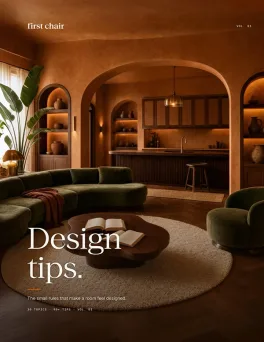
First Chair starts from a photo, either a shot of your own room or an image you saved of somewhere else entirely, such as a cafe, a hotel lobby, or a friend's place, and turns it into a room concept built from pieces that exist and ship.
Describe the direction you want in your own words and First Chair returns a coordinated set rather than a single product link. It pulls across retailers like West Elm, CB2, Crate & Barrel, Pottery Barn, and Lulu & Georgia, plus brands you haven't shopped before. That means no single company's catalog limits what the concept can include.
First Chair is built around fewer mismatched purchases and less time comparing near-identical sofas across different tabs.
What sets First Chair apart
- Room concepts come with Before & After, Video Tour, Material Board, Top Down, and Lifestyle views, so you can check scale and layout from more than one angle before buying anything.
- Every piece in a concept links to a real product page with real dimensions, not a rendering of furniture that doesn't exist.
- Insider pricing shows up next to the standard retail price directly in First Chair, so the price difference is visible before you buy rather than buried in a promo code.
- A Design Concierge can hunt for member savings and place the order for you, which matters if you'd rather approve a plan than manage five separate carts.
- Sourcing spans real brands across multiple retailers rather than one company's private label, so a concept can pair a vintage-inspired credenza with a made-to-order sofa.
Research is the expensive part of furnishing a room. First Chair's own data on shopping behavior finds that close to half of millennial furniture buyers spend two to three weeks just researching a single purchase before committing, time most people would rather spend living in a finished room.
Ideal for
- Renters and new homeowners furnishing a whole room at once rather than piece by piece.
- Anyone sitting on a folder of saved inspiration photos with no plan for turning them into an actual room.
- Couples moving in together who need to merge two sets of furniture into one coherent space.
- Shoppers who want a coordinated room concept instead of a dozen unrelated product links to compare manually.
How to Get Your First Room Concept from First Chair
The first concept takes about as long as filling out a short style quiz.
2. Chairish
Choose Chairish when you want an actual vintage or designer-label piece, not a lookalike, and you're willing to pay resale prices for it, for instance a Le Corbusier-style chair that's no longer in production. The tradeoff: because Chairish is a marketplace of individual dealers, pricing and condition vary piece by piece, so you're evaluating each seller's own photos and description rather than one curated catalog.
Architectural Digest calls Chairish a one-stop shop for decor, noting that sellers upload photos and Chairish curators decide what actually gets listed.
What Chairish does well
- Lists furniture, art, lighting, and decor across both fixed-price listings and live auctions.
- Runs auctions through a LiveAuctioneers integration.
- Curators review pieces before they go live, adding a layer of vetting beyond a raw open marketplace.
How it differs from First Chair: Chairish sells specific vintage pieces one at a time; First Chair builds a coordinated room concept around new pieces from multiple retailers.
3. Whoppah
Choose Whoppah when you want a specific designer name, like a Vitra or Cassina piece, and you want listings reviewed before they go live rather than posted raw. The tradeoff: inventory is pre-owned and limited to whatever has been listed that week, so you're searching existing stock rather than requesting something made to order.
What Whoppah does well
- Organizes search around recognizable design brands rather than generic categories.
- Reviews listings before publishing them, adding a vetting step most open marketplaces skip.
- Covers furniture, lighting, art, and designer handbags in one catalog.
How it differs from First Chair: Whoppah sells pre-owned pieces from named brands one at a time; First Chair assembles a full room from current, purchasable retail pieces.
4. Pamono
Choose Pamono when you want vintage or contemporary design pieces sourced from galleries in different countries and care about insured delivery. The tradeoff: consumer pricing isn't always upfront, since trade members shop at a separate discount tier.
Per Pamono's own site, its team sources from established and emerging galleries, shops, makers, and designers worldwide, then delivers purchases directly to the buyer, alongside editorial content about design culture.
What Pamono does well
- Ships internationally with insured delivery on every order.
- Lets you save favorite finds and get notified if they go on sale.
- Pairs shopping with editorial profiles and collections rather than a bare catalog.
How it differs from First Chair: Pamono resells sourced vintage and contemporary finds; First Chair plans and sources a coordinated room from current retail inventory.
5. The Oblist
Choose The Oblist when you want an edited set of contemporary and vintage pieces from independent studios rather than a wide-open marketplace. The tradeoff: because every piece is hand-selected by the Oblist's own team, the total catalog is smaller than an open marketplace, trading breadth for curation.
The Oblist describes itself as a singular curation of contemporary and vintage objects, offering furniture, art, and objects from independent studios worldwide, organized into collections by room and category.
What The Oblist does well
- Hand-selects every piece rather than opening the catalog to any seller.
- Organizes shopping by room, including furniture, decor, lighting, art, and vintage categories.
- Pulls from independent studios worldwide rather than one country's design scene.
How it differs from First Chair: The Oblist curates a fixed catalog of independent-studio pieces; First Chair builds a room concept that spans many mainstream and specialty retailers at once.
6. Faive
Use Faive when you already know the look you want and would rather search many design stores, vintage dealers, and galleries at once than open a dozen separate tabs, say when chasing a specific brass floor lamp silhouette. The tradeoff: Faive is a search layer across other sellers' listings, so it points you to where a piece is sold rather than assembling a coordinated room around it.
Per Faive's own app listing, it searches hundreds of design stores at once, including independent designers, vintage dealers, galleries, and global retailers.
What Faive does well
- Searches across hundreds of stores and dealers in a single query.
- Includes independent designers and vintage dealers alongside larger retailers.
- Covers galleries as well as conventional furniture stores.
How it differs from First Chair: Faive helps you find where a specific piece is sold across many sellers; First Chair solves a related problem differently by building a coordinated set of pieces for one room.
7. Etsy
Use Etsy when you want a one-of-a-kind or handmade piece from an independent maker, especially in a style a big retailer won't carry, like a hand-built oak console from a small woodworking shop. The tradeoff: because Etsy has no central warehouse and listings come from individual sellers, photos, measurements, and shipping terms vary piece by piece, so more verification falls on you.
Etsy describes itself as a global marketplace where people make, sell, buy, and collect unique pieces, with no central warehouse, just millions of individual sellers.
What Etsy does well
- Surfaces handmade and vintage pieces that large retailers typically don't carry.
- Lets individual sellers set country-specific and global pricing on their own listings.
- Covers an enormous range of styles since the catalog comes from independent makers.
How it differs from First Chair: Etsy connects you to one-off handmade pieces from individual sellers; First Chair coordinates multiple retail pieces into a single room concept.
8. Perigold
Choose Perigold when you want a retail site built around named designer shops and a trade program rather than resale, for example a shop-in-shop from a known design house. The tradeoff: Perigold's site leans on Trade and Design Services for guided help, which suits shoppers comfortable working through a trade-oriented account rather than a self-serve room concept.
What Perigold does well
- Organizes shopping around Designer Shops tied to specific brands.
- Offers a Trade program alongside standard retail search and cart tools.
- Pairs Design Services with an Inspiration section for browsing by look.
How it differs from First Chair: Perigold organizes named-brand shops for individual purchases; First Chair builds a coordinated concept across brands from a single photo.
9. West Elm
Choose West Elm when you want new furniture in recognizable collections, organized by room and style, with registry and rewards tools built in, for example registering a sectional for a move-in-together gift list. The tradeoff: West Elm sells its own in-house collections, so you're choosing from one retailer's point of view rather than a cross-section of designer labels.
West Elm's site organizes products across categories including Furniture, Outdoor, Office, Rugs, Bedding, Bath, and Lighting, with accounts that track orders, rewards, favorites, registries, and saved design boards.
What West Elm does well
- Lets you browse by room or by style rather than by category alone.
- Saves pieces to Design Boards and ongoing design projects.
- Includes a wedding and gift registry built into the shopping flow.
How it differs from First Chair: West Elm sells its own collection; First Chair sources across multiple retailers and brands for one coordinated room.
10. AllModern
Choose AllModern when you want new, modern or mid-century-style furniture at accessible price points rather than an investment piece, for example a walnut-look media console for a starter living room. The tradeoff: pieces are inspired by recognizable design eras rather than produced by the designers associated with them.
What AllModern does well
- Organizes furniture and decor by room and category.
- Groups collections around modern and mid-century-style silhouettes.
- Filters shopping by price range alongside style and category.
How it differs from First Chair: AllModern sells its own styled catalog; First Chair pulls pieces across many retailers into one concept built from your photo.
11. IKEA
Use IKEA as a budget reference point, not a designer-furniture source. It's useful for filling in the pieces around a room that don't need to carry the design, like storage or basics. The tradeoff: IKEA's catalog is mass-produced and self-designed rather than curated designer labels.
IKEA's AR tool, IKEA Kreativ, lets you experiment with placement in the room before buying, which cuts down on scale surprises.
What IKEA does well
- Lets you preview products in your room through the IKEA Kreativ AR tool.
- Covers nearly every room category in one app.
- Connects previewed pieces directly to an e-commerce basket.
How it differs from First Chair: IKEA sells mass-produced, self-designed pieces from one company; First Chair sources real pieces across many brands into a coordinated concept.
12. MADE
Choose MADE when you want new furniture organized by room and collection at a retail price point rather than a one-of-a-kind resale piece, for example a dining set for a first house. The tradeoff: like other single-retailer sites, you're limited to MADE's own collections rather than a cross-section of brands.
What MADE does well
- Organizes furniture by room and collection.
- Groups pieces around recognizable modern silhouettes.
- Lets you save and compare pieces before buying.
How it differs from First Chair: MADE sells its own in-house catalog; First Chair coordinates pieces from multiple retailers around a single room concept.
Key Features to Compare: Search, Filters, Price, and Authenticity
Authenticity works differently depending on the app. Chairish's curators decide which pieces get listed, and Whoppah's team reviews pieces before they go live. House Beautiful describes 1stDibs as a marketplace for authentic iconic furniture. Open marketplaces like Etsy rely on individual sellers' own descriptions and photos, so buyers must do their own verification regardless of the piece type.
Search depth is the next thing to check. A single-retailer app like West Elm or MADE filters within one company's own catalog, while Faive's search spans stores, dealers, and galleries you'd otherwise visit one by one. Price transparency ranges from fully public retail pricing to trade pricing that only appears once you're signed into a professional account, as with Pamono and Perigold.
Free vs. Paid: Which Apps Give You the Best Value?
Most of these apps are free to browse, and the real cost differences show up in resale commissions, trade-only discounts, and whether insider pricing is built into every piece or sits behind a separate account.
Chairish, Whoppah, Pamono, The Oblist, Faive, Etsy, Perigold, West Elm, AllModern, IKEA, and MADE do not charge buyers to browse or purchase. First Chair's membership renews automatically and can be canceled any time before the next renewal, with insider pricing included rather than gated behind a separate trade account. On the seller side, Pamono's trade program gives signed-in professionals up to 30% off, per Pamono's own site.
What Not to Buy Through a Designer Furniture App
A room concept with more than one view, like First Chair's Top Down and Before & After renders, earns its keep here. You catch the scale problem before the piece is in the elevator, not after.
- Skip the matched five-piece living room set, even when an app bundles it as one purchase. Rooms read as more considered when pieces come from different sources and eras, not a single matching collection.
- Skip rolled-arm sofas if your living room runs under about twelve feet wide. Track-arm or slim-arm silhouettes save four to six inches a side, which keeps a walkway clear and the floor visible, something a flat product photo won't show you.
- Skip "small space" pieces from mass retailers that are built thin rather than scaled down. A properly scaled sofa, even a slightly larger vintage piece with exposed wood legs, usually reads better in a tight room than several small pieces fighting for the same twelve square feet.
The Best App for Finding Designer Furniture
If you're trying to buy one specific, already-identified piece, like a particular vintage lounge chair, a resale marketplace with strong curation is the right narrow tool. But if you're furnishing a whole room and the real problem is turning a folder of saved photos into something you can actually order, First Chair is built for exactly that moment. It works from a photo, returns a coordinated concept rather than a single product link, and shows the piece from more than one angle before you commit to buying it. Insider pricing is built in rather than hidden behind a separate trade account, and a Design Concierge can place the order once you've picked what you want.
Start with your room and see what First Chair puts together from the photo you've already been staring at for months.
Frequently Asked Questions
What app turns a room photo into a shoppable furniture plan?
First Chair takes a photo of your existing room or a saved inspiration image and returns a coordinated set of real, purchasable pieces from multiple retailers. It includes Before & After, Top Down, and Lifestyle views so you can check scale and layout before buying anything, rather than evaluating a single product on a white background.
Is there an app that can identify furniture from a photo?
Yes. Dedicated photo-identification apps such as Beyit are built, per the app's own listing, to name a piece of furniture from an image and point you toward where it or a similar style is sold. First Chair works from a photo too, but instead of naming a single piece, it uses the photo to build a full room concept around pieces that already coordinate.
How do I verify the authenticity of designer furniture found through an app?
Start with how the app vets listings before you worry about the piece itself. Marketplaces with an internal curation team, like Chairish or Whoppah, review pieces before they go live, while platforms built on individual sellers put more of the verification on you, so ask for provenance details or maker's marks before paying a premium.
What is the difference between vintage designer furniture and designer-style furniture?
Vintage designer furniture refers to pieces conceived by a named designer and made by manufacturers that preserved the original intent, as defined by design authorities. Designer-style furniture is mass-produced by retailers who borrow recognizable silhouettes without a direct link to the original designer. Resale marketplaces like Chairish, Whoppah, and Pamono vet for the former; retailers like AllModern and MADE sell the latter.